





My maternal aunt (Mami) hired temporary domestic help in the kitchen because their regular staff had gone home for a month-long vacation. The new help’s work consisted of cleaning the house, washing the dishes, and occasionally helping in the kitchen.
On the second day at work, she saw that my Mamaji went into the kitchen, put on his apron, and cooked chicken. Then he helped himself to his platter and sat down to eat without any fuss and without bothering Mami to serve him. This scene hugely disturbed the new help as she related the ‘tale of horror’ to Mami that the head of the household actually entered the kitchen and cooked his own meal. According to her, the kitchen was a woman’s domain and men had no business there. She was more aghast when their son also repeated the whole ritual the next morning, fixing his own breakfast.
In another instance, my brother usually cooks his own meals. The maid considers it a norm, but when a newcomer visits, he or she is full of praise for my sibling. Why? Because he has mastered an art which is usually attributed to women.
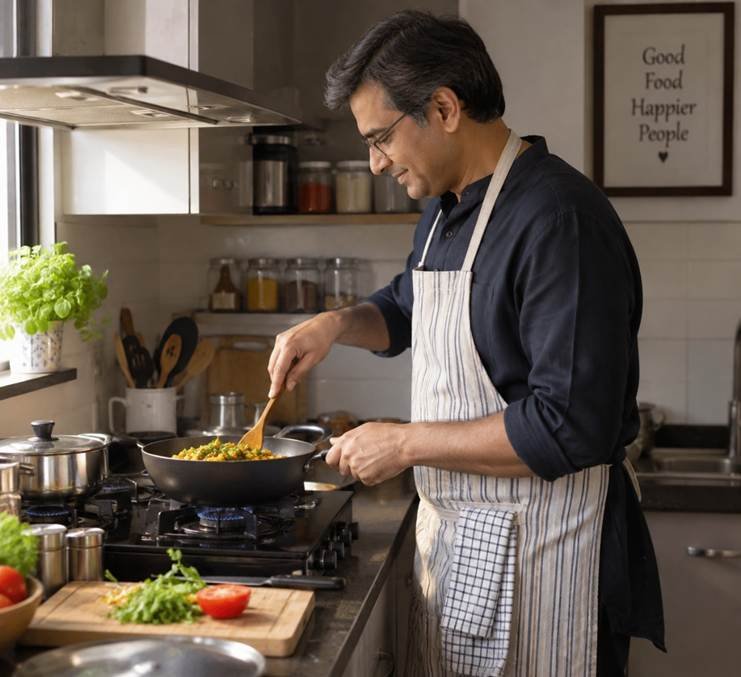
What do these two scenarios convey about the general Indian mentality toward men who cook? That his presence in the kitchen is an anomaly – and that at best he can be expected to be a guest in his own kitchen rather than a permanent host. If he chooses to be a host, he is either to be heaped with praise or taunted with terms like “joru ka Ghulam” (wife’s vassal). He is considered to be subservient to his wife.
Why do men working in the kitchen raise an eyebrow? Because men defy the gendered role traditionally given to women. In a patriarchal setup like India, women are supposed to be chained to the hearth and take up the responsibility of managing the kitchen. She is supposed to be “Annapoorna” (the goddess of food), cooking and providing meals to the entire family, especially the patriarchal head. Men are supposed to just sit and enjoy the fruits (literally) of the women’s hard work, which is then often invisibilized because there is no price attached to it. Thus, the kitchen isn’t merely a physical space; it represents a gendered division of labour, and a man entering it unsettles that arrangement.
On the other hand, we have examples of master chefs like Sanjeev Kapoor, Vikas Khanna, Ranveer Brar, and so on, whose work is highly paid. The difference between them and the women who cook is that there is a high price tag attached to the dishes they churn out, while women are expected to cook without any monetary compensation. In fact, cooking is considered to be a thankless job for women – they are not paid for it, and hardly, if at all, praised for it. It generally goes unacknowledged. Moreover, if God forbid, something goes amiss in the food they prepare – a little extra salt or no sugar – then in many Indian households, they are subjected not just to taunts but also to physical abuse.
Even if both the husband and the wife work, the expectation to take on the household responsibilities falls largely on the woman. She is expected to manage the kitchen while the husband may occasionally lend a helping hand, with a lot of praise and gratitude on the part of the women in the family.
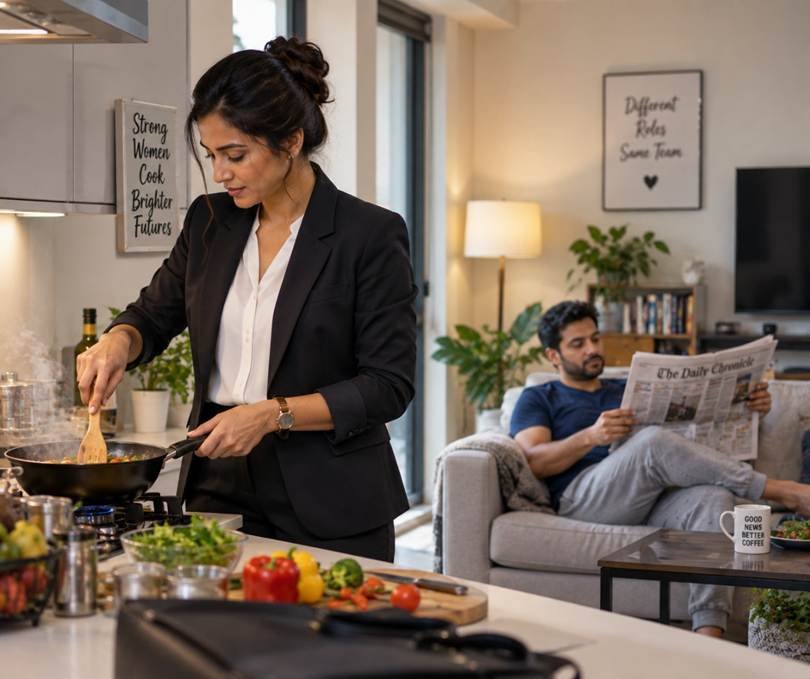
This reminds me of a short film in which Saurabh Raaj Jain featured. The name is ‘Stay at home dad/ House husband’. There is role reversal – the couple decides that since the woman earned more at the time of childbirth, she should be the breadwinner while the spouse should be the house husband. This arrangement works perfectly well for them and their daughter, till his aunt comes to visit them and is appalled to see the ‘man of the house’ ironing clothes and taking full charge of the kitchen. In fact, the lady of the house doesn’t know how to prepare a full course Sindhi dinner. The aunt here is the voice of the conventional Indian mentality which is shocked to see that the husband is no longer a guest in the kitchen but the host.
However, isn’t this desirable? Not a complete role reversal maybe, but at least the expectation that a man should be able to share the load of the woman in the household responsibilities? This is even more covetable if both the man and the woman are working. It is true that they can keep a full-time maid. Maybe more than one domestic staff member to cook and clean the house. But we all know how much we can rely on their services – they are bound to be absent at the most crucial junctures and leave the couple in a lurch. In such a scenario it would do well for the husband not to just lend a helping hand but to share half the burden as well. That too, without any sense of entitlement or expectation of extra praise. It should become the norm rather than the exception.
A male member of the family working in the kitchen should not be allowed to be an anomaly anymore. The concept may be an emergent ideology in India, but it should become the dominant one, keeping in mind the changing attitude of women towards education and employment. Naturally, if a son sees his father taking charge of half the workload at home, he will learn it from his early childhood, too. He will imbibe it as a given and not as an exception to the rule. It will lay the foundation of an egalitarian society where roles are not divided according to gender but need. Men in the kitchen should not be extraordinary but as ordinary as a woman bearing a child.


By Richa Verma
Richa is an online English teacher, independent blogger, voracious reader, a homemaker, and a movie buff who is smitten with wanderlust. She has under her belt two published books, Richa’s Musings which is an anthology of quotes, and Pendulum, a novel. She can be contacted through her email address richavermamh@gmail.com