







The recent protests at Jantar Mantar are a stark reminder that one should always raise their voice and fight for those who may not be in a position to seek justice for violations of their rights.
Let me first ask a question to you: What happens when a group of youngsters who are considered weak by the ones in power discover they have a voice and, more importantly, discover that their voices can be heard? The recent protests at Jantar Mantar point out how the government may govern the people, but it cannot exist without the people. After all, democracy is of the people, by the people, and for the people. The voice of the people can’t be ignored; we stand in the streets and public places, speak through a ballot, and through a protest.
Democracy is often limited to a mere act of casting one’s vote. However, democracy consists of much more; it involves the right to ask questions, express dissent, critique, and assemble peacefully. Power is not always measured by appearances. It is not about the one who possesses the greatest military strength, technology, and resources. Had that been the case, then the US army wouldn’t have succumbed to the feet of the Vietnamese during the Vietnam War.
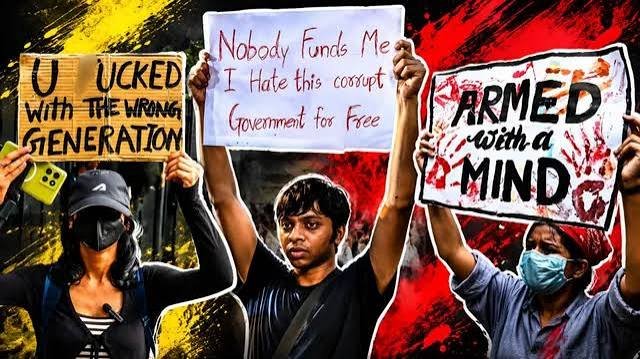
The powerful are actually those who people who dare to stand against the wrong, to ensure that justice is done, and the truth prevails. Why is it so? It is because people are not just numbers or vote banks; they have identities, aspirations, and grievances, and they can organise. The most powerful proof of all is the generation standing before us today. For years, the youth has mostly been seen as distracted, politically immature, or as individuals who can’t eat, sleep, or breathe without a smartphone in their hands.
Yes, like every generation, Gen Z has its problems. However, to dismiss the whole generation on account of this is just another type of underestimating them. The members of Gen Z have matured in an environment of fast-paced changes in the technological, economic, and social spheres. They have had information at hand, and therefore, they are the ones who know how to question institutions, shake up the hierarchy, and demand openness. And whenever they think there is something wrong, they have means to show their faces.
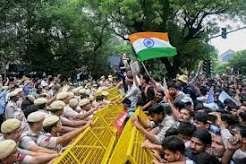
A hashtag can become a movement. A video can reach millions. A local concern can become a national conversation. The most important word in “We, the People” is not People. It is “We.” Because “we” means that democracy is collective. It means that the powerful and the powerless are ultimately part of the same national story. It means that the government and the governed cannot permanently exist in separate worlds.
And it means that the person standing at Jantar Mantar, the young student questioning authority, the voter standing in a queue, the journalist asking an uncomfortable question, and the citizen demanding accountability, all are participants in the same democracy.
When the NEET controversy raised serious concerns about examination integrity and fairness, thousands of students refused to remain silent. They were told, in many ways, to be patient. They were told to move on. But they chose to speak. And their voices could not simply be wished away. It took only the anger of a handful of youthful voices to make it a national issue, attracting the attention of the government and even the courts.
The recent series of events which saw the resignation of a minister and demonstrated the power wielded by those who have their future in their hands proves that, at times, history doesn’t start in Parliament. Sometimes, it begins in a public square. Sometimes, it begins with a question. Sometimes, it begins with a young person refusing to remain silent.
It highlights that democracy belongs to every citizen, including the student who raises a question, the young person who refuses to accept injustice, and the ordinary citizen who finds the courage to speak. So, let us never underestimate the people simply because they appear powerless. Let us never dismiss the youth simply because they are young. Do not ever confuse silence for consent. The history of mankind has taught us many times that change sometimes begins with people whom everyone thinks insignificant.
Sonali Swain
Sonali Swain is a Freelance Content writer from Delhi. She wishes to be an IFS Officer and is preparing for the Civil Services currently. She can be reached at sonaliankita18@gmail.com.






Very powerful message. Loved the spirit
Thank you
A powerful reminder that democracy is not just about casting a vote, but about having the courage to question, speak up and demand to be heard. A timely and thought-provoking piece.
Events like these remind us that the true power of democracy is the people if they are united and come forward and change things to make a better world.
Very potent and perfectly pivoted!
Thanks a lot
Very well written.
Thanks