
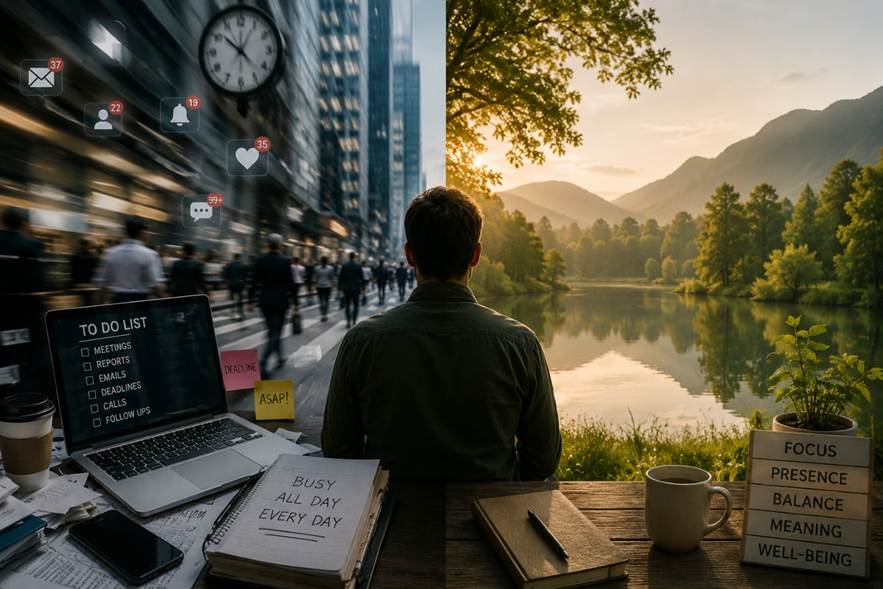

Have you ever observed some of the following instances of fast-paced living? Measuring the day by how much was “done” rather than how it felt, feeling guilty during breaks, as if time is being wasted, turning hobbies into side hustles to stay “productive”? Maybe you tend to scroll quickly, rarely pausing on anything for long, in your digital life. Or maybe you consume information in fragments – reels, shorts, headlines.
Maybe you have experienced the pressure of always “doing something” worth mentioning as conversations revolve around busyness. Have you noticed how people subtly judge someone who seems to be “too free”? Do you rush through meals instead of sitting with them, or fill every gap in the day instead of leaving space empty? If you look inwardly, have you felt that “rest” needs to be earned? There may be some anxiety about “falling behind”, or difficulty sitting still without stimulation or equating self-worth with output.
“Productivity is commonly defined as the ratio of output to input.” — Organisation for Economic Co-operation and Development.
“Productivity reflects the efficiency with which labour and capital are used to produce goods and services.” — World Bank.
Here, output means what is produced while input means what is consumed or the raw material. Higher productivity equals more output with the same input or the same output with less input. If we extend it to human life, time becomes input, work becomes output and efficiency becomes desirable.
These seemingly innocuous economic definitions actually permeate all the layers of current human life. Life has become a rat race right from kindergarten to retirement, and often beyond that. We have become goal-driven.

However, the truth about desire is that when we achieve the object of desire, it fails to satiate us because by then we tend to desire something else, and the whole chase begins again. In such a scenario, isn’t such a race endless? As Lily Tomlin says, “The trouble with the rat race is that even if you win, you’re still a rat.”
If this is the predicament of contemporary human life, then is there a way out of this vicious circle of desire after desire to achieve something else? There is, indeed, a way to break this cycle – slow living, which germinates from the Slow Movement.
Slow living refers to an approach to life which involves a more mindful, intentional and sustainable pace of life. This lifestyle philosophy encourages quality over quantity. There is emphasis on doing fewer things but with greater attention and presence. It favours balance across work, leisure and relationships. However, it should not be confused with inactivity or laziness – it means engaging time in a deliberate and mindful way.
Background and Origins
Slow living was inspired by the Slow Food Movement of the 1980s in Italy. It was a response to the opening of a fast-food restaurant near the Spanish Steps in Rome. It opposed the rise of fast food and globalisation’s effects on culture and community. The founding figure was Carlo Petrini.
However, it did not remain confined to food. It soon evolved beyond food to challenge “time poverty” and the culture of haste. The core tenets of the slow movement are as follows: it prioritises depth, care, and meaning rather than speed or output, that is, it advocates quality over quantity. It encompasses minimalism, localism and digital detox. It promotes mindfulness, that is, being fully present in what you are doing, instead of rushing through it. We should not do everything fast but choose a pace that feels human.
One needs to make conscious choices rather than react to habits or pressures, thus carving out intentional living. We should build deeper connections with people, work, food and surroundings. Respecting environmental limits and long-term impact in daily choices, that is, sustainability, is desirable. There has to be a balance between rest, leisure, and reflection as much as productivity, that is, giving equal weightage to all areas of life. Supporting local systems and appreciating simplicity over excess is highlighted. The movement questions the idea that everything must be immediate. On the contrary, it places mental, emotional, and physical health above constant achievement.
Instances of Slow Living
Slow living is not an abstract idea which we may find hard to follow. In fact, it is ingrained in simple everyday examples. For example, we may take time to eat meals without screens, focusing on taste and presence of family members or companions. Limiting screen time and consciously stepping away from constant notifications is another area. We need to choose a few meaningful tasks instead of multitasking throughout the day. Setting boundaries around work hours instead of being constantly available is desirable.
Spending uninterrupted quality time with family or friends without distractions is prioritised. One needs to practise hobbies for enjoyment rather than turning them into productivity goals or side hustles.
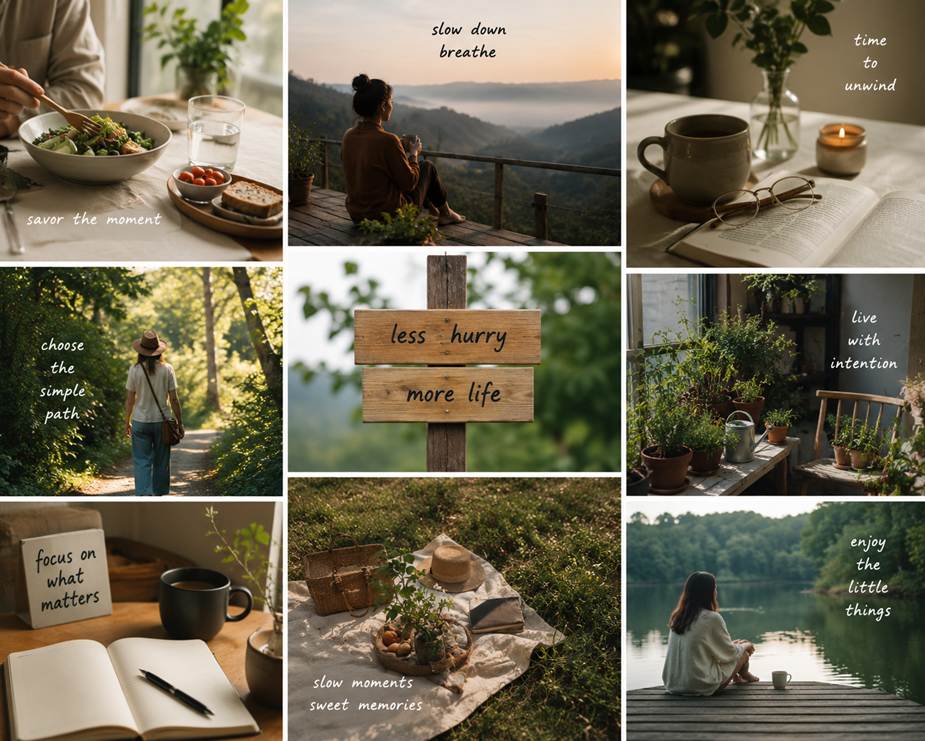
Buying less but choosing thoughtfully, focussing on quality and longevity is another instance that we can incorporate into our daily lives. Slow travel which favours immersive, local experiences over rapid tourism should be made feasible. Practising mindful habits like yoga and meditation can help. Last, but not the least, we need to learn how to allow unstructured time in the day without the need to fill every moment.
Conclusion
To conclude, I would like to quote Lao Tzu – “Nature does not hurry, yet everything is accomplished.” If we were to learn this lesson from nature, life would be so much more rewarding and ecstatic than if we were to continue in the rat race.

By Richa Verma
Richa is an online English teacher, independent blogger, voracious reader, movie buff who is smitten with wanderlust, and a homemaker. She can be contacted through her email address richavermamh@gmail.com





We are surrounded by gadgets and this fast life is fast ruining us. It’s really time to embrace slow living for a better life. Nice insightful article
“Nature does not hurry, yet everything is accomplished. ”
Profound words. Well written and meaningful article.
Thanks Sampurna and Yani!
A very intentional piece on something we need to prioritize right away!
Reminded of the Blue Zones and how people there have embraced slow living towards creating a peaceful and purposeful environment…where health and happiness permeate and proliferate…
Thanks Promita 😊 . It means a lot. And the Blue Zone is an apt analogy for what I am advocating in this article.
Very good article on the need of the hour. I feel this impact daily being part of the corporate workforce! And often slowing down in some cases is not even an option. Well written.
Thanks Manobina. ❤️It is in keeping with the corporate reality that i wrote that article. Glad it resonated with you. It is very important to have a balance in life otherwise one explodes some time or the other
These days people even track sleep. As if sleep is also a task that needs to be measured. I have personally benefitted from slow lifestyle as it helps in managing anxiety and nervous system fatigue. Loved your insight.
Thanks Bahnika! It’s true that people track everything from sleep to calories. I am glad that you have consciously striven to adopt a slow lifestyle and have benefitted from it. 😊
I am one person, done with this crazy pace . I am feeling the desperate need to slow down.
Great article
Thanks ma’am 😊. Do slow down. It’s one of the best things you can do for yourself and also your family.