






Imagine yourself being a top-notch equestrian (horse rider), pregnant with your second child. You dream to compete in the Olympics, shattering glass ceilings because till then only army men were allowed to compete in the dressage Olympic event. However, one morning you wake up to the nightmare that you have mysteriously contracted polio and your body below the waist and your hands have become paralyzed. Your doctors tell you that you may be able to walk with crutches one day but that would be the maximum possible movement, if at all possible.
What do you do?
I imagine many of us would give in to our fate, if not to despair. With polio and paralysis taking charge of our bodies, we would give up our dream of standing at the Olympic podium one day and hearing the loud applause of spectators.
Such a destiny would not sit well with Lis Hartel, whose love for horses, horse riding and dressage had been nurtured in her since her childhood days. For the uninitiated, dressage is an equestrian sport and training method – often called “horse ballet” – focused on developing a horse’s suppleness, obedience, and harmony with the rider through precise, controlled movements. How could Hartel command the body of a horse when she had little command over her own body? How could her body become one with that of the horse? To everyone around her, it seemed to be the end of her passion and career.
Except Lis Hartel herself.
But who is this Lis Hartel?
She was an equestrian world champion born on 14th March, 1921 in Denmark. Born and brought up in a family with a strong interest in horses, she began horse riding at a very young age. She demonstrated natural talent and deep affinity for horses early in life. She was trained seriously in dressage, the discipline she would later specialize in. Having been coached under experienced and professional trainers, Hartel gained recognition in national-level equestrian circles in Denmark and carved a niche for herself as one of Denmark’s leading female riders of her time. These were some of the laurels she won for herself before she contracted polio in 1944.
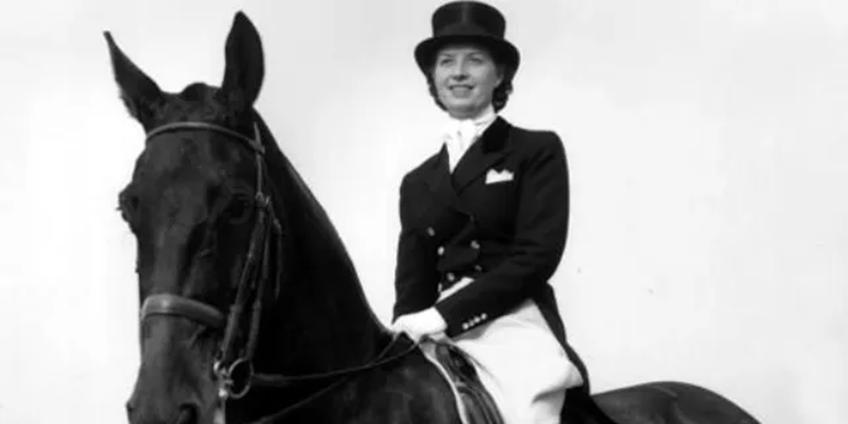
Hartel chose not to give in to her tragedy. She harboured an ambition to compete and win in the Olympics against male competitors. For this, she left no stone unturned, not just to stand up on her feet again but also to train herself to ride again. But this was a mammoth task for two reasons.
To begin with, women were not allowed to compete in this sport in the Olympics till 1948. In the post-war atmosphere, the ridiculousness of the rule soon gave way and, not only were civilians allowed to compete in dressage, but women were as well. At the Helsinki Games of 1952, the event was finally open to non-commissioned officers, enlisted personnel, and civilian men and women. Hartel was one of the first four women to compete against men in an equestrian sport.
Secondly, she had to be physically strong enough to be able to ride and control a horse again.
Step by step, day by day, she began the fight to return to the saddle. According to The Winnipeg Free Press, Hartel spent her days strengthening her body with sandbags on pulleys. She underwent two surgeries. And then, she made her request: “Take me to the stable,” she said. “I want to try Gigolo [her horse].”
“She was helped into the saddle and she rode. But after only three minutes she had to be lifted down, exhausted and put to bed for three weeks. Then she went back and tried again. Then back to bed. Then back to the horse,” The Winnipeg Free Press described.
Within eight months, she was back on her beloved chestnut mare, Jubilee, despite needing help to mount and dismount each time and taking several hard falls along the way.
So, she and Jubilee adapted. The Dane developed a completely new riding technique that relied on subtle cues and deep trust between the horse and the rider. A whisper instead of a shout. A nudge where once there had been pressure. Every movement was a lesson in trust and grace. And soon, Jubilee understood, adjusting alongside her. The pair became inseparable, sharing an almost mystical connection, and Hartel would go on to ride Jubilee in every single competition for the rest of her career.
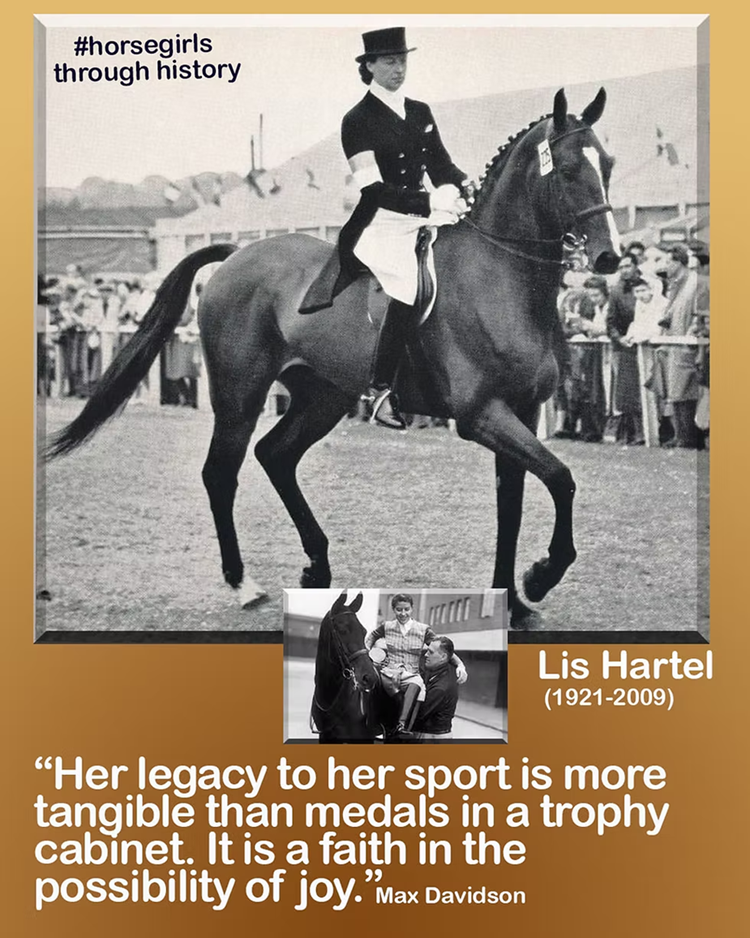
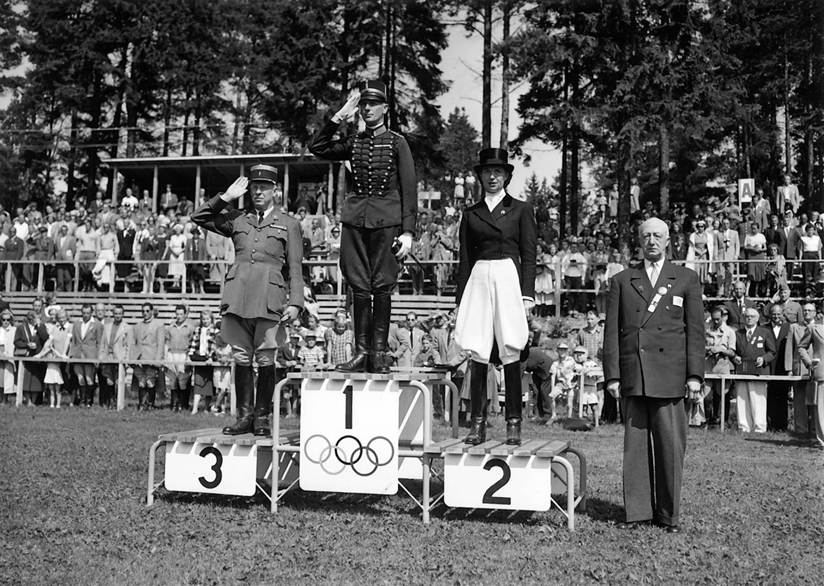
Hartel won the silver medal in the 1952 Helsinki Olympics. She had not only made history as the first woman to win an Olympic medal in equestrian sport, but she had done so in open competition, beating the world’s best men.
Henri Saint Cyr, the Swedish military officer who had won gold, stepped forward. He walked to her horse, reached up, and gently lifted Hartel from Jubilee’s saddle, carrying her, dignified, radiant, unshakable, to the podium. With the world watching, Hartel stood with effort and pride on her own two feet to receive her medal.
“The hardest thing was to stand on the podium,” the silver medallist later said.
Until that point, few in the crowd had known about her disability and, according to Hartel, other riders on the podium cried.
Hartel won another silver medal at the Melbourne Olympics in 1956.
After retirement, Hartel became one of the earliest and most influential proponents of therapeutic riding. She helped establish Europe’s first therapeutic riding centre, proving that horses could be a powerful source of emotional and physical rehabilitation for others, just as they had been for her. She worked tirelessly to promote equine therapy for those with cerebral palsy, brain injuries, multiple sclerosis and more.
The Lis Hartel Foundation, founded in her name, still champions that mission today.

By Richa Verma
Richa is an online English teacher, independent blogger, voracious reader, movie buff who is smitten with wanderlust, and a homemaker. She can be contacted through her email address richavermamh@gmail.com







interesting and inspiring article
Thanks Sampurna
Articles like these are not only inspiring but show us such vistas of life, which we weren’t even aware of!
Thanks Promita. 😊
Wow. I wasn’t even aware of such a sportsperson. Very inspiring indeed.
Thanks Narayani! 😊