






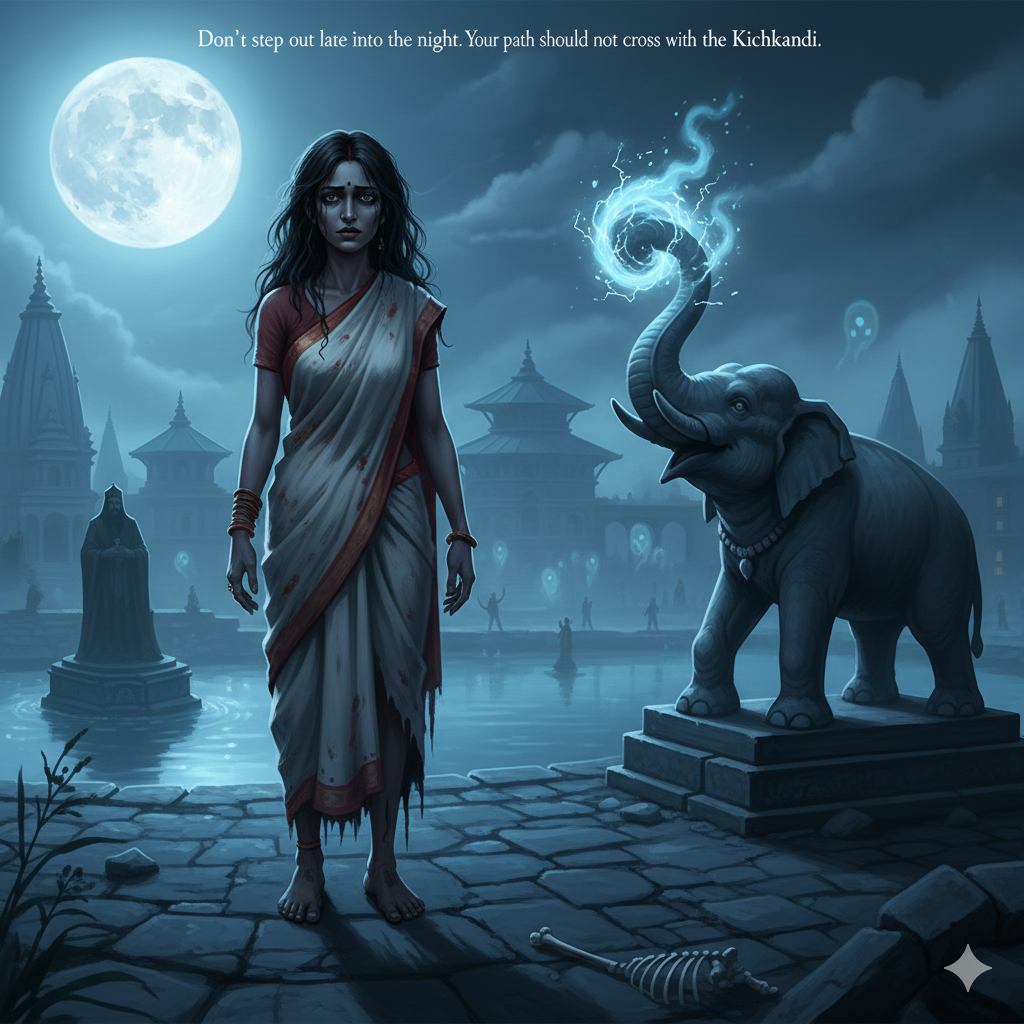
“Don’t step out late into the night. Your path should not cross with the kichkandi.” A warning often sounded by the elderly people of Nepal.
***
The Eerie Legend of Ranipokhari
Everyone has a story.
Today, my vegetable vendor shared a tale about the haunting of Ranipokhari.
Ranipokhari, an artificial pond located in Kathmandu, was constructed by King Pratap Malla in 1670 AD. This beautiful pond was built for the queen who tragically lost her firstborn. However, there is more to its history than meets the eye. A legend shrouds its waters, adding an air of eeriness and intrigue to the serene environment.
They say that after the construction of the pond, King Pratap Malla would visit Ranipokhari regularly, drawn to its serene beauty. One fateful day, during one of his visits, he chanced upon a beautiful woman by the water’s edge. Captivated, he found himself falling deeply in love. The pond soon became a secret haven for their daily rendezvous.

However, as their relationship blossomed, a shadow loomed over the king. Ever since he met this mysterious woman, his health began to decline rapidly. Physicians were summoned to diagnose his ailment, but none could uncover the cause of his suffering. As the days passed, the king’s vitality dimmed, leaving those around him increasingly concerned.
Meanwhile, their passionate union bore a child, but the joy was tragically short-lived. In a shocking moment, the woman took the life of their child right before the king’s eyes. As he stood there, stunned by grief and disbelief, he noticed something unsettling about the woman – her feet were turned backward.
A chilling realization struck him – she was not human, but a monster!
But he kept his composure, deliberately overlooking the strange events and holding to his act.
The Trap
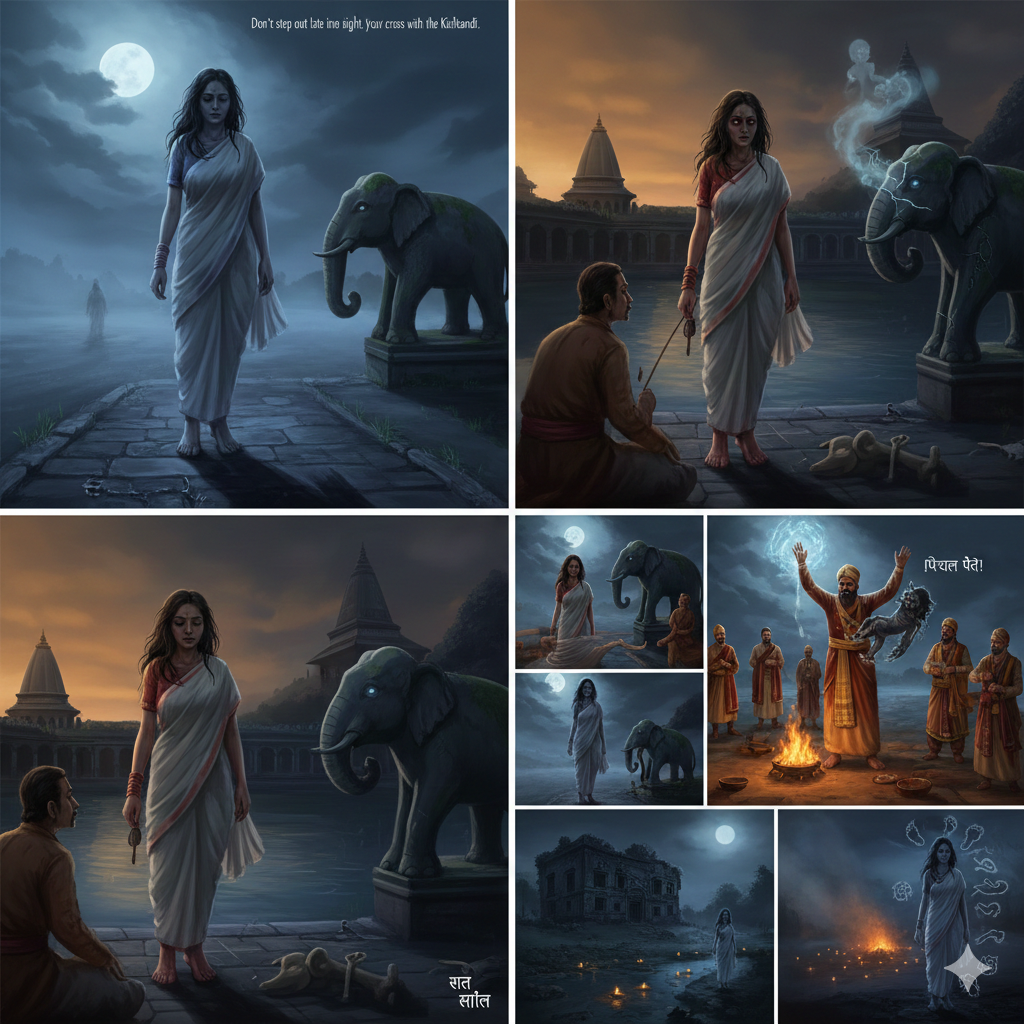
Later that day, in consultation with the court priest, a trap was set. As the woman bathed, the king stealthily tied a string to the hem of her garment. Following this trap, the royal entourage was led to a grave discovery. A human shinbone resting on the pond floor! All doubt vanished. This was no common beast, but the Kichkandi!
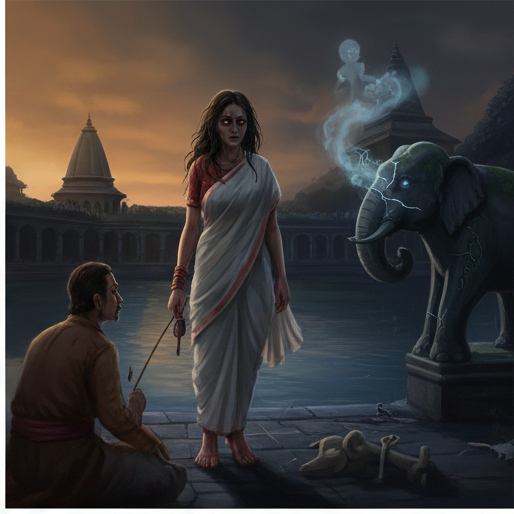
The priest and his disciples performed an elaborate ritual which involved the cremation of the bone, an act that finally broke the Kichkandi’s spell over the king. His health, which had been slowly failing, recovered with surprising speed. However, peace did not return to the land. An evil presence still clung to Ranipokhari. It was the vengeful spirit of the child the Kichkandi had murdered! Recognizing the crisis, the king summoned the priest again and issued an order. “Do what is necessary.”

The priest stood upon the banks and performed an ancient rite. He used his powers to breathe life into the stone statue of the elephant that stood at the pond’s edge. “Grasp the pishacha!” he commanded. The structure moved, its trunk capturing the demonic sprit and locking it into a tight embrace for all the years to come. This is how Ranipokhari was finally freed of the evil. That mighty elephant, forever gripping the trapped spirit, still stands vigil on the bank – a witness to the horror that clouded the serene waters of the pond.
The Kichkandi
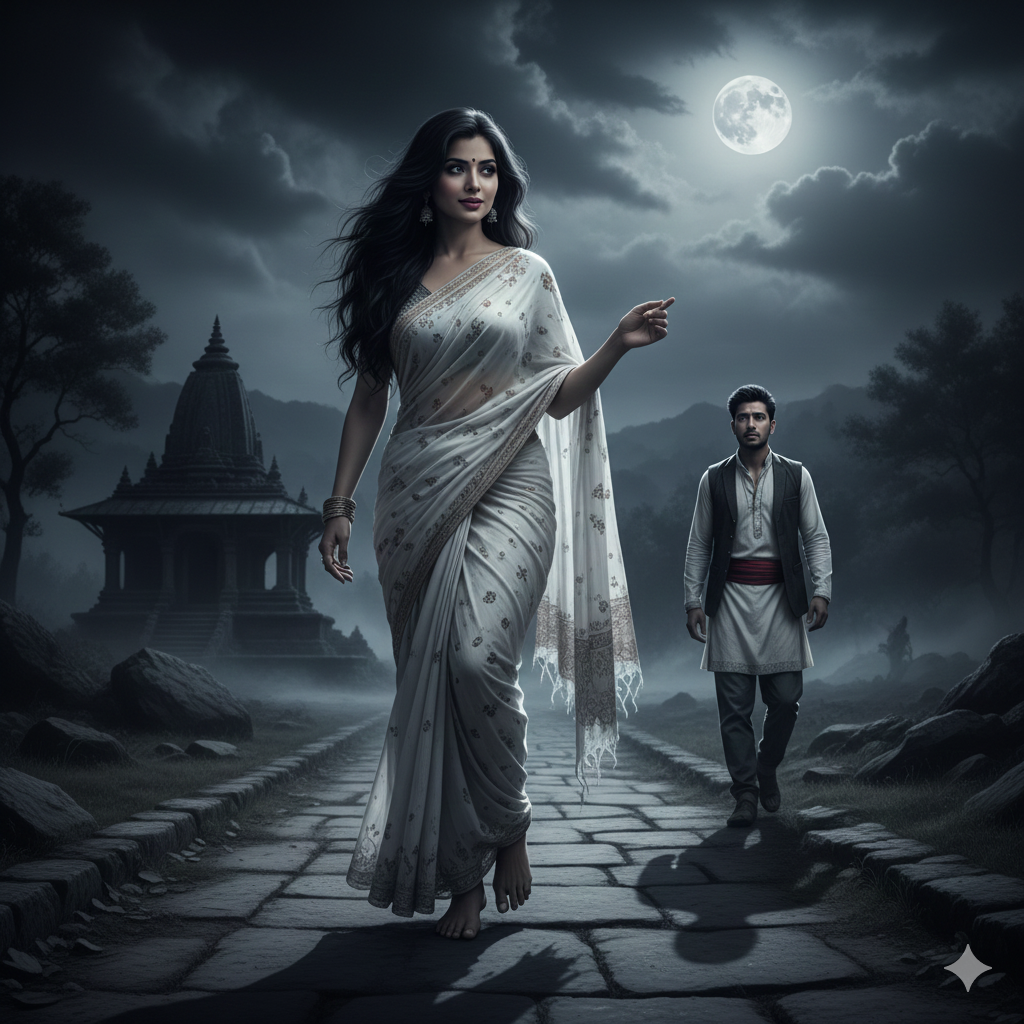
The Kichkandi is a female entity, a pishacha or a vengeful ghost. Typically draped in a white sari the defining feature is her cursed anatomy – her feet that face backward.
She is the manifestation of a woman’s deep anguish – either betrayed and rejected by a faithless lover, or someone who endured a lifetime of mistreatment and abuse. Her untimely and tragic end, often heightened by the improper execution of her last rites, fuels her malice. Countless theories abound regarding the sorrows that give rise to the feared Kichkandi.
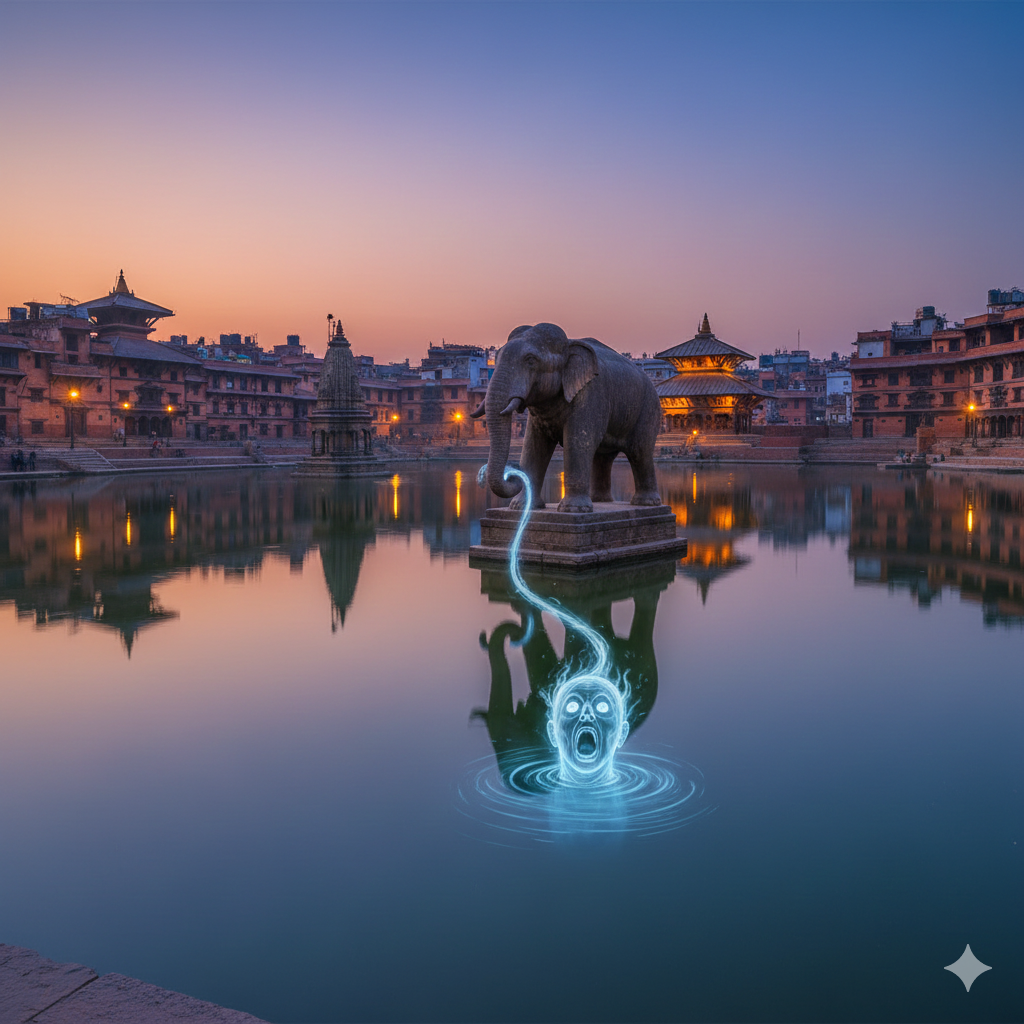
But she is without doubt, a victim! Often a distressed woman stranded on a lonely road, pleading for help. Worse, she can be a vision of irresistible beauty, trying to charm an unsuspecting man, only to reveal her terrifying secret. She preys on solitary travellers in the deep night, luring them with her face before destroying them. She is known to prowl desolate spaces – empty stretches of road late at night, abandoned houses, and the grounds of crematoriums. Locally, she is said to be sighted haunting the banks of the sacred Bagmati River, specifically near the ghats where the final rites are carried out.
But the lore is complex. Some argue that she is not a predator, but a bereft, lonely soul searching for company, whose intent is not always malevolent.
Even the sighting of a Kichkandi is considered a bad omen guaranteed to bring bad luck or a sudden, severe illness to the witness.
Parallels in other folklores
The legend of the Kichkandi is not confined to Nepal alone. Tales of her revenge are also prevalent in the mountains of Himachal Pradesh. She has numerous parallels in the Indian folklore as well. She is kin to the vengeful Churail of North India, the terrifying Pichal Peri of Punjab, and the malevolent Petni or Shakchunni found in Bengal and Bangladesh. All these female spirits share a common purpose – they are tragic and powerful entities out to exact revenge on unsuspecting men.
The Paradox of the wronged woman
It is interesting to analyse the depiction of female spirits in South Asian folklore. These ghosts are characterized as “wronged women” – victims of domestic abuse, rejection by lovers, forced widowhood, or violent murder. The portrayal captures the power dynamics where women are deemed inferior to the other sex and lack control over their mortal lives. The irony lies in the fact that these women, who have always remained subjugated and powerless throughout their physical existence, suddenly acquire immense supernatural strength and authority after death. The finality helps them exact revenge and achieve a terrifying form of justice. For them, death becomes an unexpected form of liberation – a freeing agent that finally empowers them and grants them a brutal sense of closure.
Death, is perceived not an ending but a transformative catalyst that grants them the power they were denied in their living form.
From the Kichkandi to the Churail, these ghosts are symbols that capture the paradoxical nature of womanhood. These spirits remind us that feminine power lies hidden, either repressed or subdued by societal structures. It is reserved for moments of ultimate crisis. The spirit manifests its full, terrible potential when all other avenues for justice have been exhausted. When this energy is unleashed, it is an unstoppable force that seeks to engulf and rectify the injustices of the mortal world. The spirit’s power is a warning: what society seeks to suppress or destroy will inevitably return with terrifying, supernatural might.
This duality, the potential for both creation and terrifying destruction – is what makes these female spectres compelling and culturally significant.

By Sreemati Sen
Sreemati Sen holds a Masters in Social Work from Shantiniketan. A Development Professional,
she has specialized in Psychiatric Care of Differently-abled children. Years of experience in
Social and Consumer Research are also a part of her portfolio. Her stories have been featured in
various anthologies.
She can be contacted at Sreemati123p@gmail.com.