




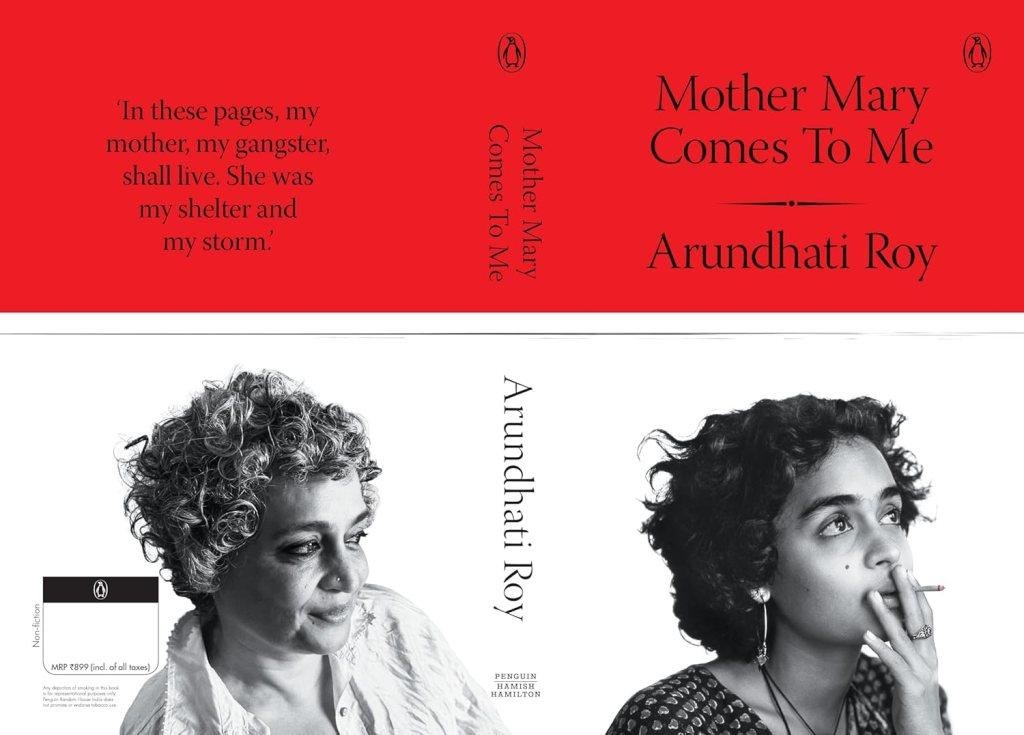

A book I fell in love with just by beholding its cover, I must confess, is MOTHER MARY COMES TO ME by ARUNDHATI ROY. A ravishing red cover with an intricately etched black moth on it, the book felt like an invitation to explore an intimacy that was dormant yet drawing. Little did I know then that my intuition was aligned to the memories that was to be unravelled between the covers of the book.
Mother Mary Comes To Me is a memoir that you can strongly hate or passionately feel for but never ignore the experiences lived within it. Apparently, it is about the relationship that Arundhati Roy shared with her mother, Mrs. Mary Roy. The rear cover bears testimony to this fact by declaring that “In these pages, my mother, my gangster, shall live. She was my shelter and my storm.” The description, certainly, makes it evident that Roy had a very complicated and contradictory relationship with her mother, which affected her not only while her mother was alive but also after her death.
Roy categorically writes that in this book she “mourn(s) her as a writer who lost her most enthralling subject.” Mary Roy was the acclaimed author, Arundhati Roy’s solo subject, “a terror and a wonder to behold” and unknowingly or otherwise, it is her formidable presence that features in Roy’s books except her works as a women’s rights activist. Perhaps even there her “soul-crushing” upbringing must have shaped the persona that she emerged into.
Through a non-linear narrative, the book traces the growing up days of Arundhati, her leaving home at eighteen, her difficult times in Delhi, which she calls “a different country altogether,” the evolution of an internationally famous writer and political activist and the repercussions she had to face for her ventures. But the underlying element is the presence of her mother, who was the reason behind the emergence of a writer, who could turn her pain and humiliation into purpose and acceptance of a rare kind.
Mary Roy is a rather confounding character and I was totally taken aback by her extremes. She was an excellent educator, who would give all the “light” she had to her students, only to make sure that her children “had to absorb her darkness.” Angry and abusive, she made her children shrink from their own skin, while taking the responsibility of the children of innumerable others by offering them education and values through the Pallikoodam School in Kerala.
Not only literacy and education but also women’s legal rights were the causes Mary Roy championed relentlessly. She did not budge till she won a landmark case in the Supreme Court of India against unequal inheritance laws, which barred Syrian Christian women from the right to property in Kerala. It was through her, Arundhati admits, she learnt to think, to be free and to write. She was undeniably the catalyst in Roy’s journey towards intellect, independence and integrity.
With her brother, whom she calls, LKC, Arundhati shared a special bond, which was, however, not enough to hold or heal her. After one of the incidents in which she was publicly insulted by Mrs. Roy for serving coffee in a teacup to the genius architect, Laurie Baker, she sat on the steps and her brother sat next to her and “silence sat between us (them) like a third person. A well-loved friend.”
Another interesting character in the book happens to be G. Issac or Uncle Chacko. Ammu’s older brother, a Rhodes scholar and a pickle baron, he showed Arundhati that “making friends with defeat is the very opposite of accepting it.” Imbibing this art would help the writer in the long run as she would continue the process of writing, practising and learning through Bargad, Annie, Electric Moon and finally, her first published essay, In a Proper Light. The process stretched and after The Rape-Trick essays, finally emerged, The God of Small Things.
The other characters who played a role in the ‘becoming’ of the book were Arundhati’s entomologist grandfather; her grandmother; her father, ‘The Nothing Man’; Golak, her friend in Delhi; Pradip Krishen, her understanding husband and a documentary filmmaker; Carlo; John Berger and a couple of others.
The setting of the eventful memoir keeps shifting from Ayemenem, the humid, river-bound village in Kerala to Assam and Tamil Nadu, where the children accompanied their mother after their parents’ separation, and then to Delhi, where she studied architecture and eventually became the writer and the activist, one often merging into the other. There are mentions of beaches of Goa and a few other places which Roy travelled to for family or work purposes. The fluidity of the setting adds pace to the narrative and emphasises the nomadic nature of the writer’s life.
The theme that the book primarily delves into is centred around the ‘shelter-storm’ paradox and explores engagingly how trauma and trepidation can create magnificent art and meaningful activism. The clash of the public and the private personas is another potent theme of the memoir. But the significant strands, which bind the two women despite their differences are freedom and feminism. Memory plays a crucial role in the book as does the process of writing and the shaping of the individual voice of an author.
For me, the most striking element of the book is the language and writing style of Arundhati Roy, a language in which describes herself as ‘a valiant organ-child’, ‘a scrawny bonsai plant’ and ‘an off-grid drifter.’ Of course, reading plays an integral role in the making of the writer and she mentions Kipling, Shakespeare, Joyce and many others that she kept reading as she grew up. Also, ‘Free Writing,’ which was one of the foundational practices in Mrs. Roy’s school, encouraged her to write what was on her mind. Images and metaphors make a writer’s language immersive and I am reminded of radical expressions like “I became the back seat of the van” and “I became her lungs and her body… a secret operative, breathing my life into hers.”
Unique and intensely impactful is what I feel the language of Mother Mary Comes To Me is. It’s a language that she generated, organised and disciplined through a protracted process till she found her exclusive language and when she was equipped with her own language, her cold moth “spread her wings” though she couldn’t tell whether “she was preparing to take off or land.” And gradually, out of her language emerges literature, which “can join humans in a bond of quiet intimacy the way almost nothing else can.”
“A cold, furry moth on a frightened heart” is the writer’s constant companion. Perhaps it is a paradoxical metaphor for sadness and safety simultaneously and it compels me to go back to THE GOD OF SMALL THINGS to find out where and how it originated and to wonder if it will continue to flutter in the writer’s heart and her outpourings.
And while you might be overwhelmed by what you experience between the covers of the book, do hear the iconic song, Let It Be by Beatles to let go of all that is beyond your control and embrace your life as it is here and now!

By Promita Banerjee Nag
An avid word enthusiast and content-churner, Promita is fuelled by novel writings, ideas and light-hearted banter. A teacher by passion, she treads the path of unequivocal learning with and through her students. Mother, music and ‘mishti’ mostly convince her. If you wish for a tête-à-tête, feel free to reach out to her at promita033@gmail.com.