






According to MedlinePlus, “Haemophilia is a rare bleeding disorder in which the blood does not clot properly. This can lead to problems with bleeding too much after an injury or surgery.” You can also have sudden bleeding inside your body, such as in your joints, muscles, and organs.
Types of Haemophilia
There are several different types of haemophilia, but the most common are types A and B. The former (Classic Haemophilia) is caused by a lack or decrease of clotting factor VIII (8), while the latter (Christmas Haemophilia) is caused by a lack of factor IX (9)
Causes
Haemophilia is linked to the X chromosome, which is why it is more common in males, while females are more often carriers. It is usually inherited, which means it is passed down genetically from parents to children. It happens because the body has too little or no clotting factor, a protein needed for normal blood clotting. As mentioned earlier, haemophilia A is caused by a deficiency of factor VIII, while a deficiency of factor IX causes haemophilia B. In some cases, a person may have haemophilia even without a family history, due to a new genetic mutation.
Symptoms
- Bleeding into the joints. This can cause swelling, pain or tightness in the joints. It often affects the knees, elbows, and ankles.
- Bleeding into the skin (which is bruising).
- Bleeding into the muscle and soft tissue, which can cause a build-up of blood in the area (called a hematoma).
- Bleeding of the mouth and gums, including bleeding that is hard to stop after you lose a tooth.
- Bleeding after circumcision.
- Bleeding after having shots, such as vaccinations.
- Bleeding in the head of an infant after a difficult delivery.
- Blood in the urine or stool.
- Frequent and hard-to-stop nosebleeds.
Diagnosis
Many people with a family history of haemophilia request their doctors to conduct tests on their babies after birth. About one-third of babies who are diagnosed with haemophilia have a new mutation not present in other family members. In such a case, without family history, a doctor might investigate for it if a baby shows signs of haemophilia.
For diagnosis, doctors perform blood tests to determine if the blood is clotting properly. If not, then they perform factor tests, also called factor assays, to diagnose the cause of the bleeding disorder to ascertain the type and severity of haemophilia.
Treatment
To treat haemophilia, one needs to replace the missing clotting factor so that blood can clot properly. This is usually done by injecting replacement clotting factor into a vein. The replacement clotting factor may be either made from donated human blood or in a laboratory – this type is called a recombinant clotting factor. This can help treat a bleeding episode.
In more severe cases of haemophilia, the patient is injected with the factor regularly to prevent bleeding. They may also learn how to inject the factor to manage on their own.
There are other medicines to treat haemophilia. They may work by releasing factor VIII (8) from where it is stored in the body tissues, replacing the function of factor VIII (8), or preventing clots from breaking down.
If bleeding has damaged your joints, physical therapy may help them function better.
Good quality medical care from healthcare professionals who know a lot about the disorder can help prevent some serious problems. Often, the best choice for care is to visit a haemophilia treatment centre (HTC).
World Haemophilia Day and its purpose
World Haemophilia Day is observed every year on 17th April to raise awareness of haemophilia and other bleeding disorders. It encourages early diagnosis, promotes access to appropriate treatment and care for people with this disease, highlights the challenges patients face (such as limited resources and stigma), and advocates for equal healthcare access across countries and communities. It also calls attention to the global need for better medical facilities and support systems, encouraging research and development for improved treatments and potential cures.
Recent themes: 2025 and 2026
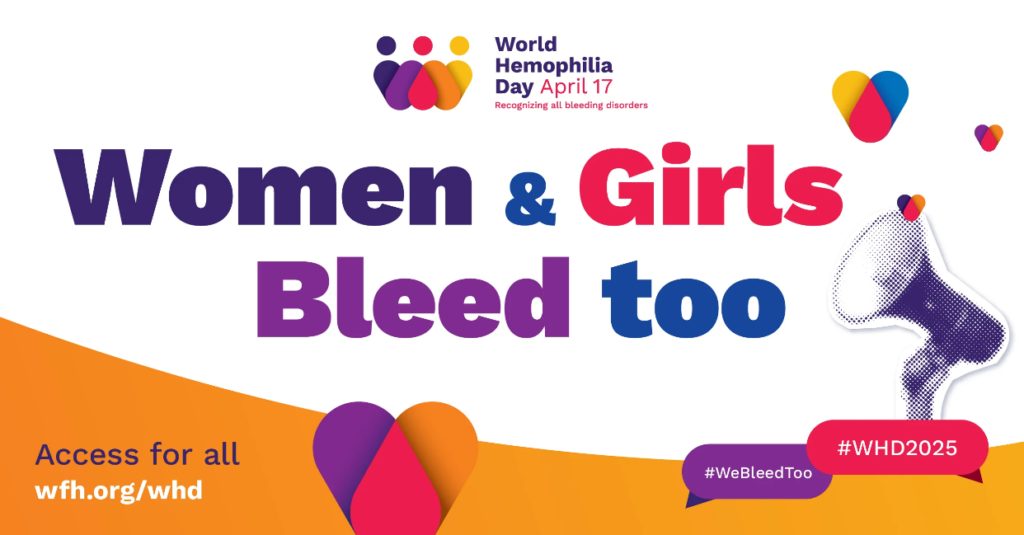
The theme for 2025 World Haemophilia Day was “Women & Girls Bleed, Too”. According to Cesar Garrido, WFH President, “Recognising women and girls with bleeding disorders is a significant milestone for our community. In the past, they were often viewed solely as carriers rather than individuals with a bleeding disorder. It is time to fully embrace and acknowledge their experiences and struggles. Prioritising the diagnosis and treatment of women and girls is crucial, and doing so strengthens our entire bleeding disorder community. Join us on April 17 to show your support for access for all—including women and girls.”
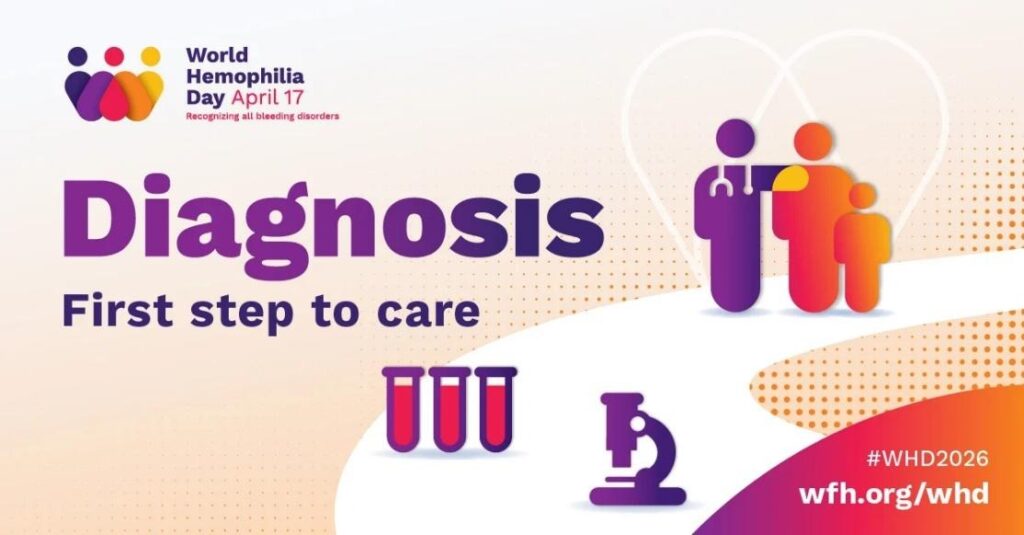
In 2026, the theme is “Diagnosis, the First Step to Care.” The WFH estimates that “over three-quarters of the population of people with haemophilia worldwide are undiagnosed, and an even more significant gap also exists for other bleeding disorders. This means that hundreds of thousands of people with bleeding disorders around the world still lack access to basic care. We have the power—and the shared commitment—to change this. We can improve diagnostic outcomes by strengthening healthcare professionals’ skills and enhancing laboratory effectiveness. By increasing global diagnosis rates, we can move one step closer to our shared vision of Treatment for All.”
Conclusion
Haemophilia is a lifelong condition. However, it can be effectively managed with awareness, timely care, and the right support. There are organisations in India, like the Haemophilia Federation (India) (HFI) and its regional chapters, that offer guidance and assistance to patients and their families. They ensure that they are not alone in their journey.
Haemophilia Federation (India) (HFI)
Phone: +91-11-45034951 / 4972, +91-11-41552819
Email: support@hemophilia.in

By Richa Verma
Richa is an online English teacher, independent blogger, voracious reader, movie buff who is smitten with wanderlust, and a homemaker. She can be contacted through her email address richavermamh@gmail.com










Good article for the benefit of women and girls. Congrats
Insightful indeed
A very informative and intentional article!
Thanks Ranjana Phua, Preethi Ma’am and Promita.
Crisp. To the point. Coincidentally reading this on 17th April.
Thanks Bahnika!