





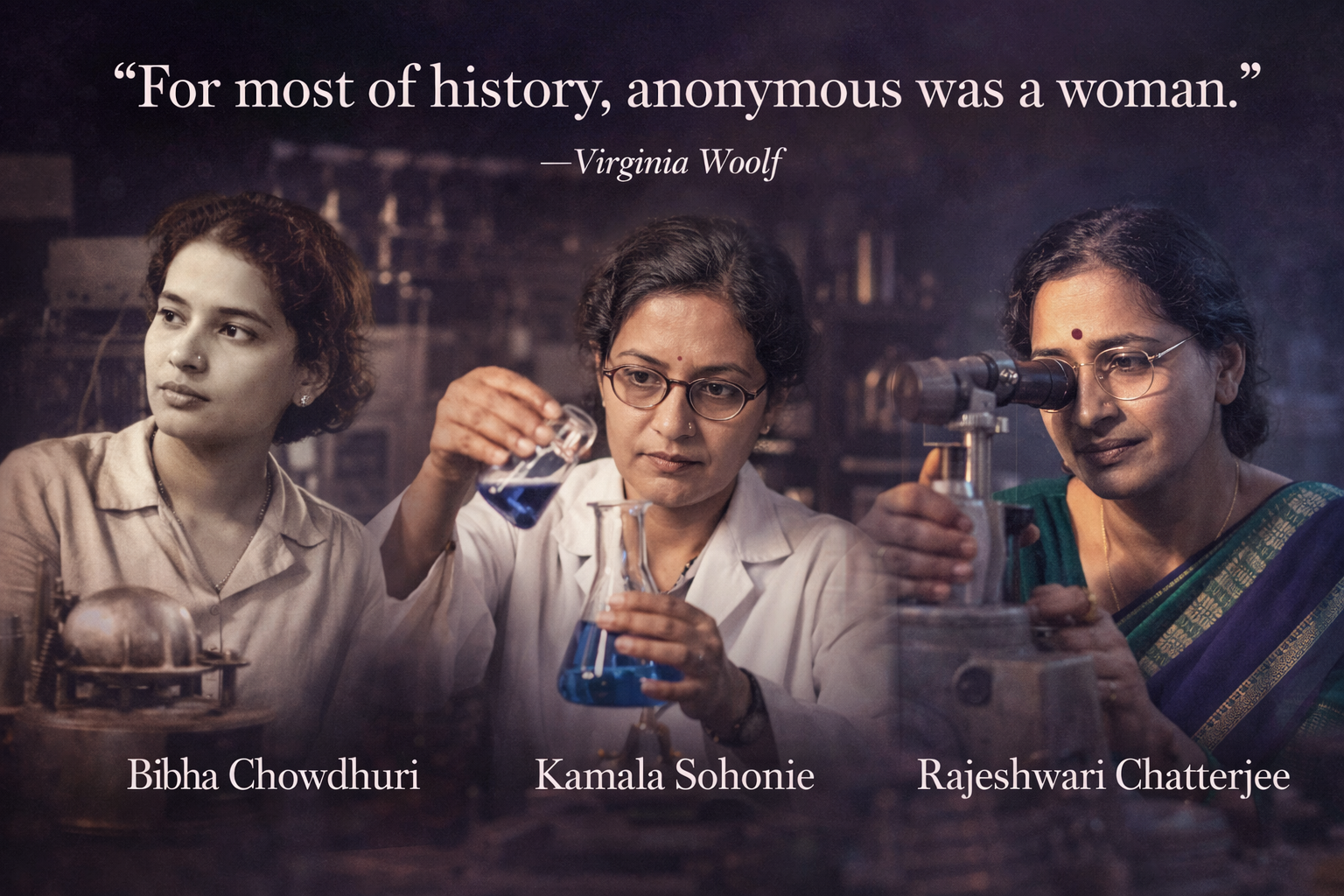

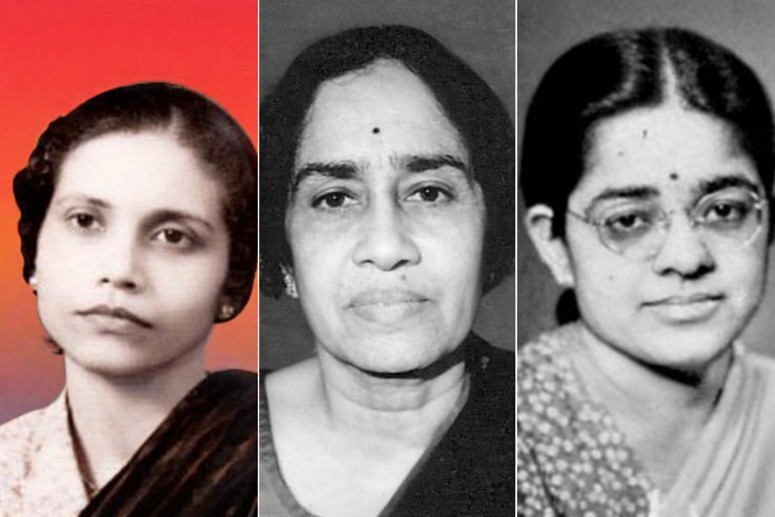
Bibha Chowdhuri, Kamala Sohonie, Rajeshwari Chatterjee
“For most of history, anonymous was a woman.”
This statement by Virginia Woolf underscores the struggles and contributions of women throughout the ages. It highlights the pervasive erasure of women’s voices and achievements from historical records. In a patriarchal setup, women are relegated to the margins, the periphery, while the credit for their endeavours is taken by men in various fields of intellectual, creative, and revolutionary activities. HERstories are silenced, their names forgotten, their legacies overshadowed by their male counterparts. While women have been written out of many domains of Indian history, science perhaps bears the deepest silence — because its records exist, yet its women are still missing.
In this article, we focus on three such Indian scientists whose names have undergone systemic erasure and whose stories (HERstories) we need to know and celebrate.
Bibha Chowdhuri
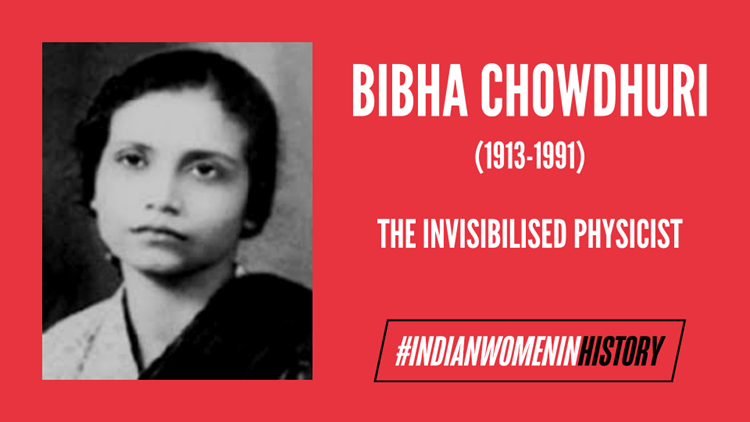
Bibha Chowdhuri was one of the earliest Indian researchers in particle and cosmic ray physics, working on cosmic rays when the field was still developing globally. She conducted research at the University of Manchester, working under Patrick Blackett, a Nobel laureate. Her experiments provided early evidence of subatomic particles (mesons) produced by cosmic rays. She co-authored papers that contributed to the understanding of particle showers generated by high-energy cosmic radiation. She was among the first Indian women to pursue advanced research in experimental physics abroad. Later worked at the Tata Institute of Fundamental Research (TIFR), contributing to India’s early particle physics research ecosystem.
Barriers
Working in a field almost entirely dominated by men, Bibha Chowdhuri limited visibility and professional support. Her early experimental evidence on cosmic rays was overshadowed, with recognition largely going to male collaborators. There was a lack of sustained institutional backing in India, restricting the continuation and expansion of her research. Her contributions were minimally recorded in textbooks and popular science histories, leading to long-term erasure. Unlike male peers, she did not receive timely public recognition or major scientific honours during her active years.
Kamala Sohonie
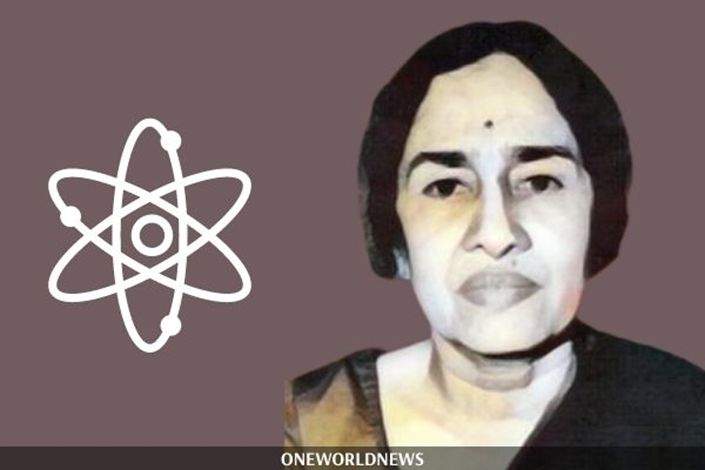
Having been one of the first Indian women to earn a PhD in biochemistry, Kamala Sohonie carried out pioneering research on nutritional biochemistry. She focussed on proteins, vitamins, and trace elements in Indian diets. She highlighted the nutritional value of indigenous foods such as pulses, legumes, and rice-based diets. She conducted important studies on neera (palm sap), establishing its value as a nutritious supplement for malnourished populations. She later became the Director of the Institute of Science, Bombay, contributing to science education and research leadership in India.
Barriers
Like Bibha Chawdhury, Kamala Sohonie faced explicit gender discrimination early in her career, she was initially denied admission to the Indian Institute of Science (IISc) because of her gender. When she was finally allowed to study at IISc, it was only under special restrictive conditions, which reflected deep institutional bias. As a woman working in biochemistry, she struggled with resource crunch. She produced socially significant scientific work. However, her contributions remained largely absent from mainstream scientific narratives. Recognition of her work came late and sporadically which was not the case with her male contemporaries.
Rajeshwari Chatterjee
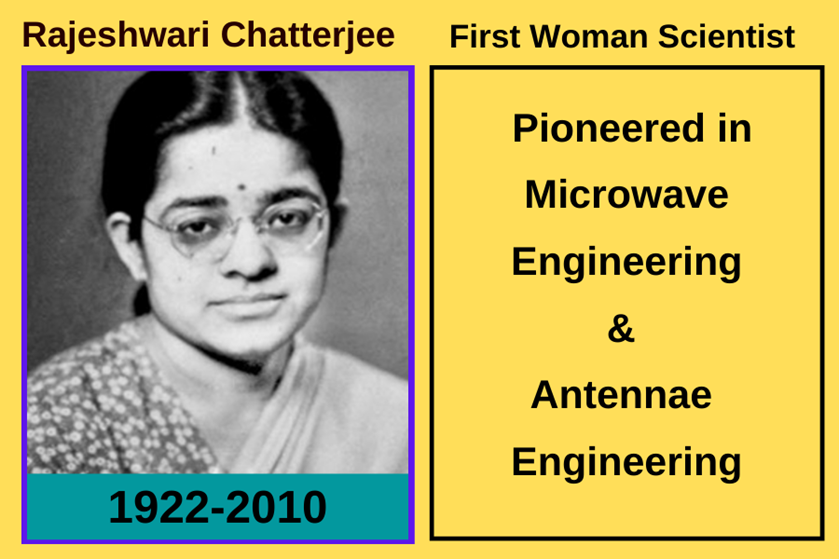
Rajeshwari Chatterjee excelled in the field of microwave engineering in India, which was crucial to radar and communication technologies, playing a foundational role in establishing microwave and antenna research at the Indian Institute of Science (IISc), Bengaluru. Due to her research there was significant advancement in radar systems, waveguides, antennas, and microwave instruments. Her co-authored technical books, including Microwave Measurements and Rays, Waves and Antennas, became key reference texts. She trained and mentored generations of engineers and thus helped build India’s early expertise in defence and communication technologies. She quietly but critically contributed to India’s self-reliance in high-frequency and radar-related research.
Barriers
Rajeshwari Chatterjee worked in a highly male-dominated field where women engineers were rarely visible or acknowledged. She contributed significantly to IISc, but her contributions were often subsumed under institutional achievements rather than credited to her individually. Unlike her male contemporaries, her work in defence-and-technology-oriented research was invisibilised. Textbooks and popular histories of Indian science and engineering find only token representation of her contributions. When recognition arrived much later, it pointed to a systemic undervaluation rather than lack of impact.
Conclusion
These stories remind us that women were never absent from Indian science, even at the nascent stage. They worked, contributed, built institutions, even while being marginalised. Recovering their HERstories is, therefore, not a corrective gesture. It is a necessary re-reading of how Indian scientific history has been narrated. There was no occasion better than International Women’s Day to set forth this task, as retrieving these HERstories put the limelight back on these marginalised women scientists.

By Richa Verma
Richa is an online English teacher, independent blogger, voracious reader, movie buff who is smitten with wanderlust, and a homemaker. She can be contacted through her email address richavermamh@gmail.com







Well articulated article…
Thanks Kirti. 😊
What a beautiful tribute to some of the unseen women of Indian Science!
Informative and well-researched…
Thanks Promita!
fluconazole over the counter
fluconazole over the counter
finasteride topical
finasteride topical
lamictal for anxiety
lamictal for anxiety
doxycycline monohydrate 100mg for acne
doxycycline monohydrate 100mg for acne
sildenafil in neonates
sildenafil in neonates
cenforce 150 mg review
cenforce 150 mg review