





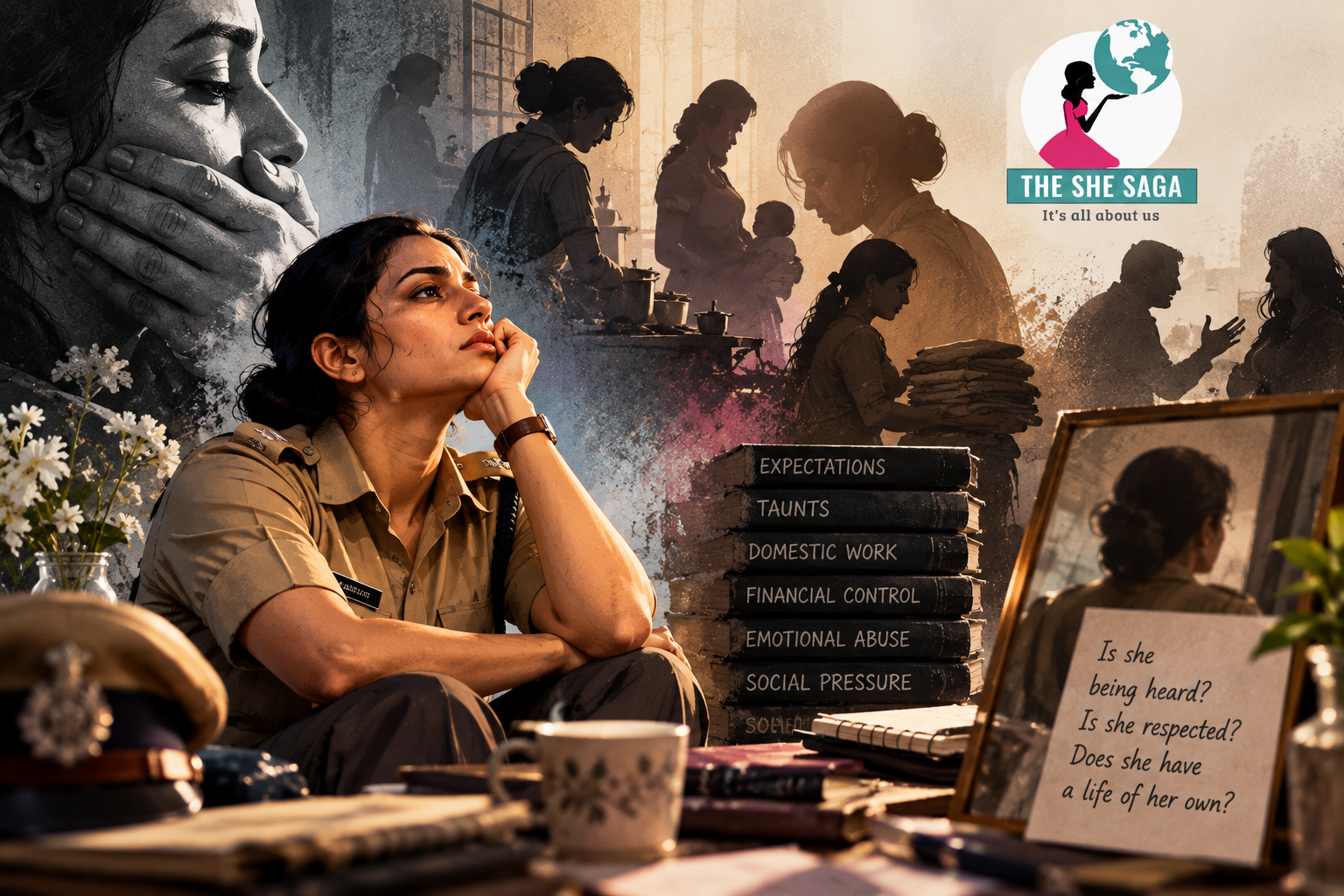

It took me years to understand that violence or torture is not just physical, but can be deeply emotional. It’s not the physical scars that harm you, but the mental burden that weighs you down. A recent watch, ASI Babita Singh Reporting on Prime, made me probe deeper into the many ways a woman can be silenced. This article is more like a personal reflection than a movie review.
How many of us have seen stories that make us feel uncomfortable, or how many such stories are there that make us feel uncomfortable because you suddenly realise how certain things have become so normalised? This is exactly what I kept thinking while watching ASI Babita Singh Reporting. How easily we recognise violence when it is visible, be it a woman being beaten, burnt, bruised, or harassed. But what about those marks that you can’t see on the body?
Those constant taunts, humiliation, the expectation to be the perfect wife, bahu, and being financially independent but not really having a say in how the money should be spent. Recently, Archana Puran Singh, as a judge on a comedy show, said: “All across the world, women are only working; it is only men who say that it is not work, as they don’t consider it as work.” It made me realize how easy it is to dismiss a woman’s work just because it is not considered important enough.
Your mother, wife, daughter, or sister may be working all day at home, but it would be seen as “her duty.” If she steps out and gets a job, she is still expected to carry out her domestic responsibilities, which takes me back to a quote I saw on Instagram: “What all a woman could achieve, had she had a wife at home.”
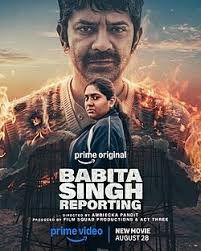
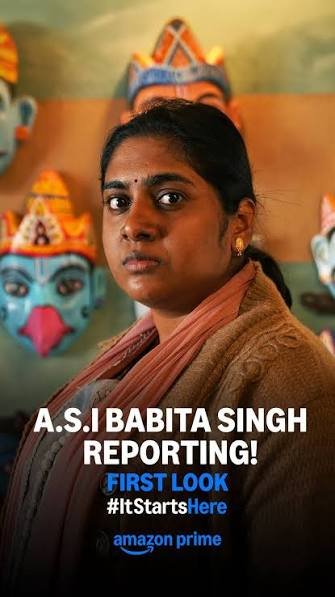
In the movie, we see how Babita, a cop, takes care of her family, manages her household, and attends every function; she is trying her best to meet her husband’s and her in-laws’ expectations, yet she is constantly told, “Achi naukri nahi hai tumhari.” Her uniform and her worth are disregarded throughout. So, what exactly qualifies as work when it comes to a woman?
The constant taunts of being childless, of being from a different caste, not being slim, slowly seem to take a toll. This makes me think how abuse does not become acceptable just because someone else has suffered more. Emotional abuse is abuse. Mental abuse is abuse. Verbal humiliation is abuse. Being constantly made to feel inadequate is abuse.
She is shown as a kind, soft-spoken, people-pleaser who wants to be good in everything that she does, but somehow her efforts are not just enough; she is never seen or recognised, regardless of whether she is in the uniform or not.
She is exhausted and deserves a break; despite being physically unwell, she is still expected to bend down, touch the feet of relatives, carry gifts, smile, and perform the role of the ideal daughter-in-law. Nobody seems to be concerned about her; no one notices the pain behind those smiling eyes.
Her husband cant’t see to stop complaining about her earlier absence during family functions and how he has to be the one to answer why she has been unable to conceive to date. As if her body exists to make his social life easier. It is shown as if he is ashamed of being with her, but has no shame in taking away her money and spending it.
One of the smallest moments in the story says so much. When the time comes, her husband quickly takes away the money she has saved and gives it to his mother, so that everyone believes he was the one who contributed. It is such a minute act, yet it captures something much bigger. A woman’s contribution can be erased in seconds. She can do all the work, yet the credit goes to the man, because he is supposed to be the provider.
Then there is another dialogue in the movie: “Aurat na mere baap se sambhli, na mere bhai se…” This stayed with me for a reason. Why do we have to be handled at all? Why is my independence seen as something that has to be controlled? Ultimately, this is what society wants: to keep women within boundaries that someone else has drawn for them. Patriarchy survives not only because men enforce it, but because generations have been taught to accept it as normal.
Amidst all this chaos is Bansi, Babita’s childhood friend who matters so much. He is shown as the only one who makes her feel seen. He hears her. He respects her. He takes a stand for her. And sometimes, that is all a person needs to realise that they are more than the roles people have assigned to them. And then he is no more, her death seems to be what drives Babita to find herself. It’s like even after death, Bansi is helping Babita to realise her strength.
What the movie really made me think about is how a woman slowly disappears inside the roles she is expected to perform. And perhaps that is the uncomfortable truth the story leaves us with: Not all women who are suffering look like victims. Some may be smiling, or going to work, or being told they are “lucky” because their husband doesn’t hit them. What we need to instead ask is: Is she being heard? Is she being respected? Does she have a life of her own? Can she say no without being punished for it? Is she allowed to exist as a person? Because a woman shouldn’t have to be beaten or burned before we decide that she deserves better.
Sonali Swain
Sonali Swain is a Freelance Content writer from Delhi. She wishes to be an IFS Officer and is preparing for the Civil Services currently. She can be reached at sonaliankita18@gmail.com.






Yes, emotional trauma is as bad as phsyica scar. And sometimes takes years to heal.
You aptly conveyed what I exactly felt throughout the movie. This movie would have made huge numbers at the box office had it been a box office release. Such underrated gem
I have watched the movie and agree with every word. Aptly written article.
So precisely put! Experienced the same emotions and felt the same concerns while watching the movie…