






As modern readers, we are usually familiar with the term ‘helicopter parenting’. For the uninitiated, a helicopter parent, who is also known as a cosseting parent or simply a cosseter, is a parent who is regarded as overattentive and overly fearful for their child, especially outside the home and particularly at educational institutions. They have earned this epithet from the fact that, just like helicopters, they “hover overhead”, overseeing every aspect of their child’s life.
Some examples are called for here. Mrs Sharma comes to school with a bottle of juice, a packed lunch, and an umbrella, one hour before the dispersal time of her child. This happens despite the fact that her home is at a distance of five minutes from the school, there happens to be no clouds in the sky, and the child is in grade 8, quite capable of walking home alone.
Or take the example of Mrs Roy. She sits with her child while she does her homework, then she double-checks what she has done. She is known to often call the teachers of her ward for clearer instructions.
In other words, these are extreme examples of how some parents want to shield their children from adverse situations, any kind of discomfort, or challenges in life. A disadvantage of this helicopter parenting is that the child tends to lean deeply on their parents, making them incapable of taking decisions on their own.
A Contrast – Obstacle Parenting
In contrast to the concept of helicopter parenting is the emergent term, ‘obstacle parenting’. The scope of this article is to understand the meaning and ramifications of this concept which is very useful for capacity development of the children.
According to Nancy Bergeson, “Instead of removing every challenge, obstacle parenting gives kids space to face small struggles and learn from them. It’s about doing less, not more, and trusting that kids can figure things out.”
This is the core idea of obstacle parenting. Obstacle parenting means deliberately allowing children to struggle with challenges rather than swooping in to solve problems for them.

Examples:
Suppose you are in a four-hour-long flight. Your daughter has finished watching a movie on her tab and is getting bored. She is nagging you for this reason. You could tell her that sometimes it is a good idea to get bored. Then you could watch the clouds from the window or check out the interior of the plane and ask her to describe it. Thus, boredom can lead to creativity.
It means limiting screen time so that the child finds out other ways to kill time. As Roald Dahl comically portrays in his famous poem, ‘Television’, keeping children away from the idiot box allows them to get engaged with the imaginary world of books. Similarly, instead of allowing unrestricted screen time to your children, you could ask them to read a book or indulge in some other creative activity.
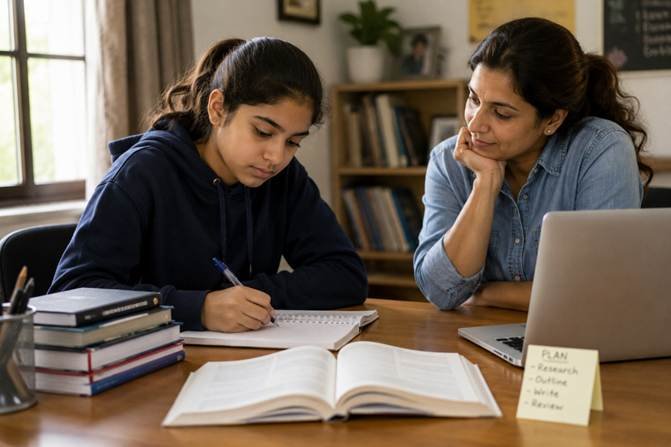
In another instance, suppose your child has got a school project to do. Instead of doing it yourself, allow the child to explore and discover methods to do it herself. Of course, your guidance is imperative, but don’t solve each little problem that the child encounters while preparing her project. If she needs to go to a special organization in order to collect material, you may go with her, but she should be the one making the enquiries and holding the conversation rather than being a mute spectator while you conduct the entire interview yourselves. It will hone her soft skills and the skill to navigate unfamiliar situations and strangers.
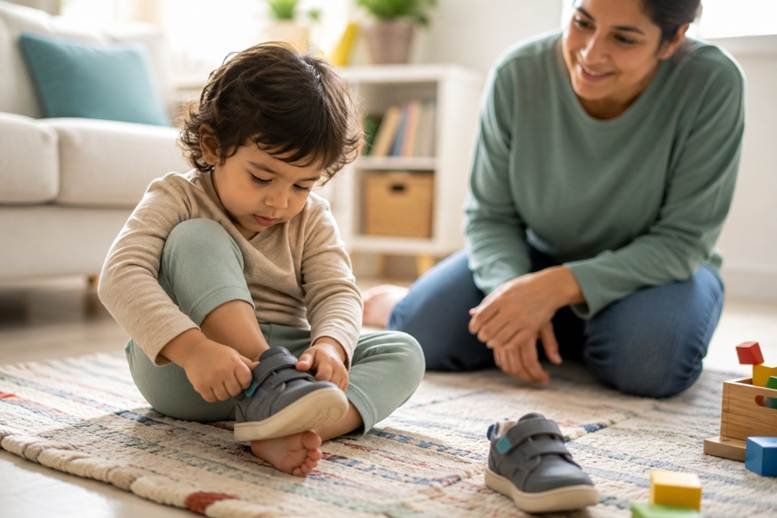
Of course, the kind of obstacles should be age appropriate, just like the projects given to children in the school are age appropriate. One cannot expect the same level of maturity from a ten-year-old and an adolescent.
Benefits
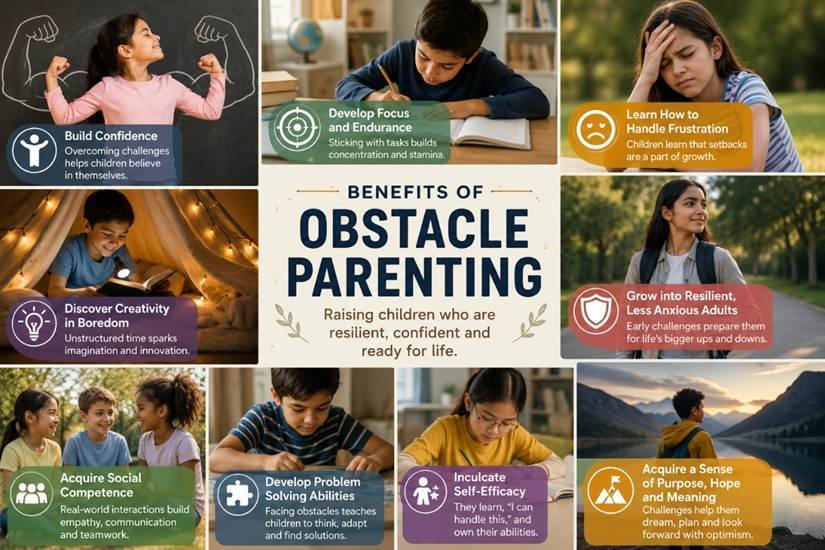
Obstacle parenting isn’t about making life hard for children. It’s about giving them space to:
- Build confidence.
- Develop focus and endurance.
- Learn how to handle frustration.
- Discover creativity in boredom.
- Grow into resilient, less anxious adults.
- Acquire social competence
- Develop problem-solving abilities
- Inculcate self-efficacy
- Acquire a sense of purpose, hope, and meaning (optimism about the future).
Conclusion
We live in a world which is in flux. We may not always be around to take care of our children. Ultimately, it is their lives with their own sets of challenges. At a particular juncture, they are bound to leave the confines of their homes and step out into the world. Obstacle parenting helps to develop the important skill of adapting to the ever-new climes. It helps the children to acclimatise to environments which demand creative thinking and being on their toes. If they have been in the habit of leaning on their parents for all their needs, even the unspoken ones, they are bound to falter as adults in real life, away from their parents. Hence, prepare them to be on their own while they are still within your protective reach when required.

By Richa Verma
Richa is an online English teacher, independent blogger, voracious reader, a homemaker, and a movie buff who is smitten with wanderlust. She has under her belt two published books, Richa’s Musings which is an anthology of quotes, and Pendulum, a novel. She can be contacted through her email address richavermamh@gmail.com