





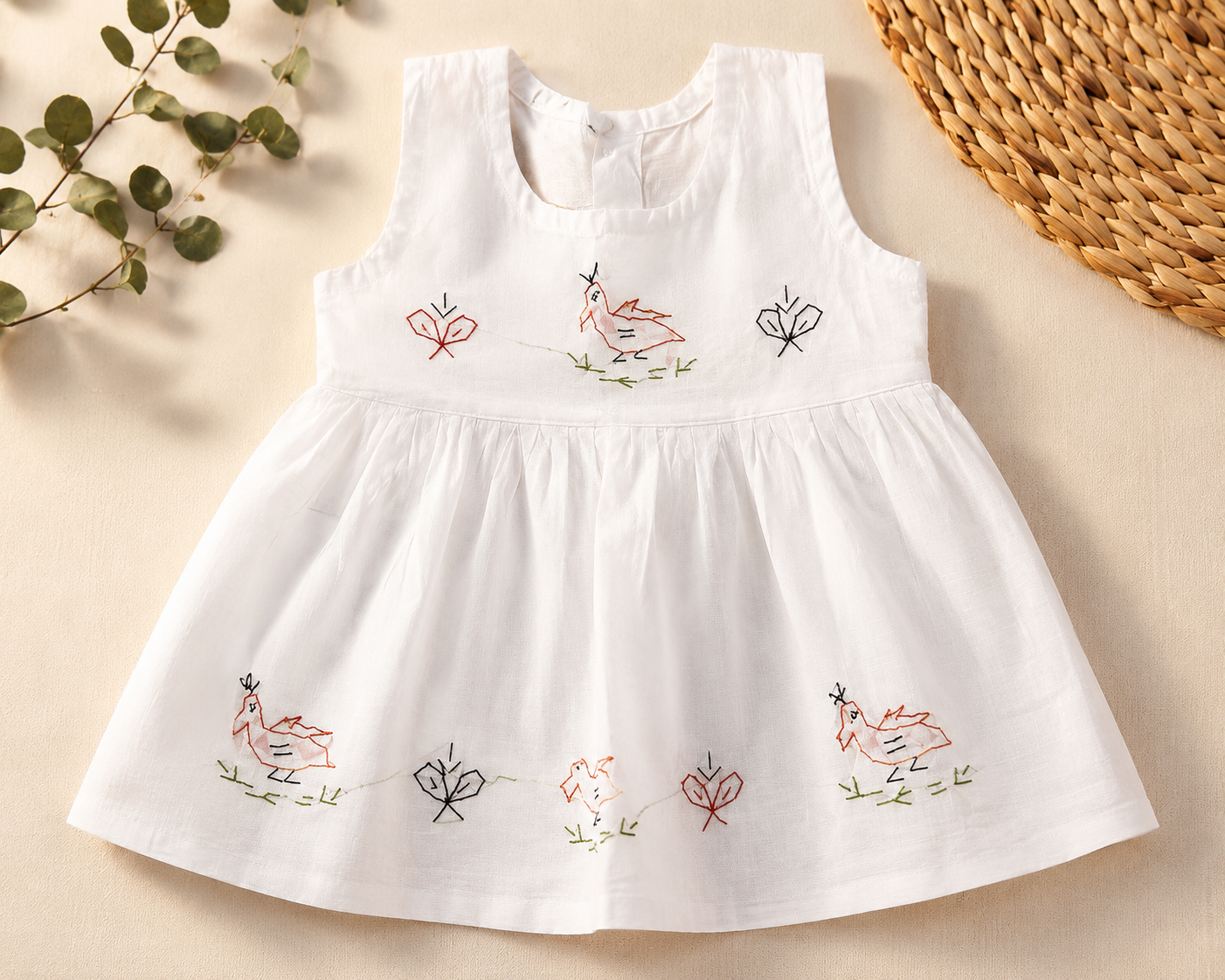

Summers in Bengal have always been defined more by humidity than by heat. Few bright, sunlit days pass without an evening shower bringing temporary relief, only for the moisture-laden air to return and settle heavily over the landscape.
In such a climate, nothing feels more comfortable than lightweight, breathable cotton. Yet many traditional cotton garments that once suited Bengal’s weather perfectly are gradually disappearing. Among them is a cherished relic of Bengali childhood – the tape-frock, or tape-jama in Bangla.
In Bengali, jama simply means garment. The origin of the word tape is less certain, though it likely referred to the tape measures used to determine the dress sizes in which these frocks were sold.
For generations, the tape-jama was a near-universal feature of Bengali households. Worn by girls from infancy through their pre-teen years, it served as the quintessential summer outfit for much of childhood. It was practical, comfortable, and deeply woven into everyday life.
Tape-frocks were often gifted during Poila Baisakh, the Bengali New Year, making them both festive and functional. Crafted from soft, breathable cotton, they were perfectly suited to Bengal’s hot and humid climate. Their loose, flowing silhouette allowed unrestricted movement, making them ideal for active children.

Traditionally, these dresses were made from addi cloth, a fine variety of cotton. They were typically sold heavily starched, giving them a crisp and structured appearance. Today, the few tape-frocks still available in local markets are usually softer and unstarched, reflecting changing consumer preferences. While they have not disappeared entirely, they no longer occupy the central place they once held in Bengali childhood.
The story of addi cloth itself offers a glimpse into Bengal’s economic and cultural history. This is the same white cotton fabric often used for men’s kurtas. The name addi derives from an old unit of currency: one-sixteenth of a rupee, represented by a handful of cowries. Legend has it that a bale of this cotton once sold for an addi, and over time the price became the fabric’s name.
The tape-jama’s utility extended well beyond childhood. Girls wore it comfortably from infancy until their pre-teen years, and many continued to use it as an improvised chemise during adolescence. Worn beneath outer garments, it provided a breathable layer between skin and clothing. Long before “moisture-wicking” became a marketing buzzword, the humble cotton tape-frock performed the task effortlessly – and at a fraction of the cost of today’s fashionable synthetic alternatives.
A typical tape-frock featured a gently gathered empire waist, positioned high on the torso to maximise comfort and freedom of movement. Its beauty lay in its simplicity, enhanced by delicate shadow-work embroidery executed in bright, colourfast threads. Shadow work is created using the herringbone stitch worked on the reverse side of the fabric, producing softly coloured motifs outlined on the front. The designs drew inspiration from the local world: flowers, leaves, birds, and fish adorned the garments with understated charm.
Tape-frocks were once sold in stacks of varying sizes across markets and bazaars throughout Bengal. To my knowledge, alongside cutwork petticoats, they were among the region’s most widely carried textile gifts. Every summer, families travelling to visit relatives would pack fresh tape-frocks into light-brown paper thongas – handmade paper envelopes secured with bell pins. Each package contained a specific size requested by family members living outside Bengal, who eagerly awaited these practical reminders of home.
Over time, however, changing aspirations and imported fashions altered our relationship with clothing. As Western silhouettes increasingly shaped our tastes, the loose and airy tape-frock began to seem old-fashioned. It stood in stark contrast to the fitted slips that became popular through advertising and popular culture. Designed originally for colder climates and made from knitted fabrics intended to retain body heat, these body-hugging garments somehow found favour even in India’s tropical weather.
How could a simple cotton dress, hand-embroidered and perfectly adapted to local conditions, compete with the glamour projected by glossy advertisements featuring fashionable models? The tape-frock was practical, but practicality rarely wins against aspiration.
Yet it would be simplistic to blame the slip alone for the tape-frock’s decline. Its disappearance reflects broader social and cultural transformations. As India became increasingly connected to the world through television, advertising, and later digital media, new ideas of fashion, modernity, and success began to influence everyday choices. We were all moving forward, eager to embrace what appeared new and sophisticated, often without pausing to ask where exactly we were headed.
In that pursuit of glamour and global belonging, perhaps we overlooked the quiet wisdom of garments that had evolved in harmony with our climate and way of life. The tape-frock was more than a dress; it was a thoughtful response to Bengal’s weather, a marker of childhood, and a small piece of cultural heritage.
As it fades from memory, one cannot help but wonder: in our enthusiasm for glitter and novelty, have we also lost something lighter, gentler, and better suited to who we are?
Have we, in chasing shine, inadvertently shut ourselves off from the simple comfort of light?

By Sampurna Majumdar
Sampurna Majumder is a communications professional born and raised in Kolkata. Fascinated by creativity from a young age, she has a deep love for music, literature, and world cinema. An avid reader and traveler, she holds a Master’s degree in Literature from the University of Delhi.






This is so relatable and heartfelt. I so want one tape jama for my daughter but i couldn’t find “the one”. There are many variations available but not those displayed in the picture and described by you. I miss tape jama and reading the article feeling nostalgic. Never in my wildest dream I ever thought that tape jama can bring up so many emotions.
Thank you Banhika
Oh dear! Such a nostalgic article. I used to wear the tape jama too. We used to call it ‘shimmy’. Later on, I realised it was actually chemise. Sad. It’s been relegated to memories. They were so comfortable.
Thanks Yani. Glad that you liked it
This is such an informative and nostalgic article. Though not in Bengali, I remember wearing these too.
Thanks Richa. Happy that you enjoyed reading the article
Such a heartwarming article filled with nostalgic nuances of a cherished clothing of Bengal! And of course, its been a comforting piece of my childhood too…
Thanks a lot Promita. Am glad that it brought a smile to your face
fond memories. beautifully written
Thanks a lot Debjani