







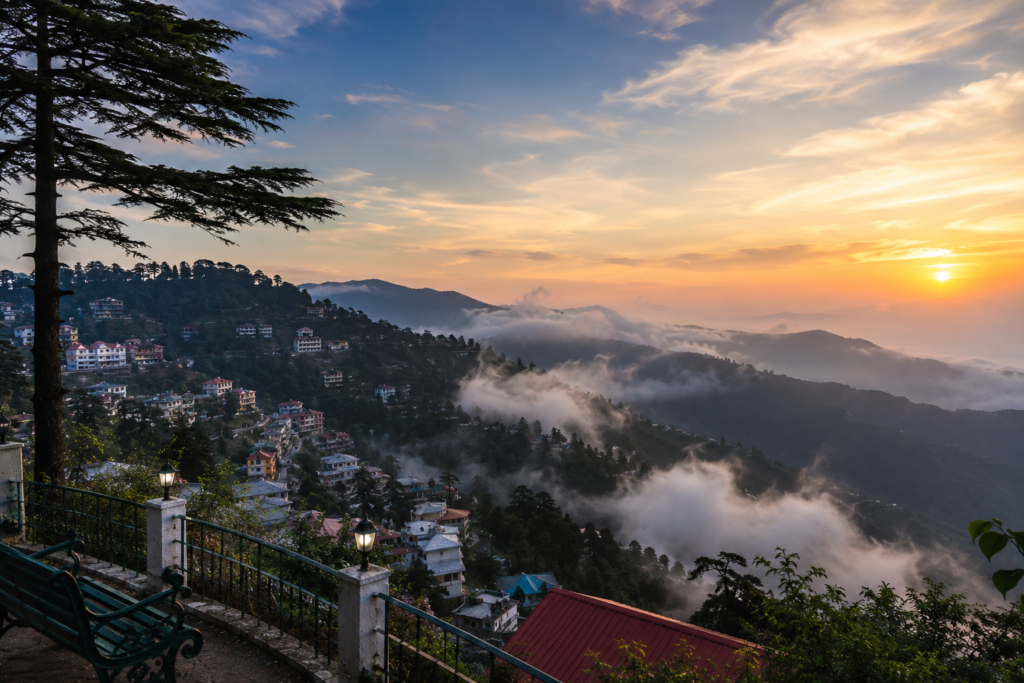
Mussoorie and melodies make a beautiful backdrop to tell us that this is a story of journeys. The journey of every musafir or traveller, which becomes memorable when he has a true companion, a partner, who either stays with him or leaves with lessons and unlived moments.
While you mull over the misty thoughts, you are drawn into a story that begins somewhere in Bhopal. Café and coffee remain at the core while a guy, Chander, who finds logistics a little less boring than life in the city plainly falls for a girl, Sudha, who prefers experiencing life to watching those of others in a darkened theatre hall. The unconventionality of the relationship right from the outset is as enticing as the ask, “Do you live less on Mondays?” I am taken only to agree that life is to be lived every moment as much in ordinariness as in excellence.
The story oscillates between Chander’s past in Bhopal and his present in Mussoorie and traces the trajectories of three lives, including Chander across deliberate distances and different timelines. Chander, a software engineer, who feels free in the mountains and ultimately responds to his calling to run a quaint café amidst them is in contrast to Sudha, an ambitious divorce lawyer, who is determined to make it big in the city that never sleeps. To give company to the dreamy and the daring is the placid presence of Preeti. The wanderlust in her seems to have paused (for a while, as she claims) to be in the present and find its expression through words and writing.
The meanderings in the lives of these three characters played by Vikrant Massey (Chander), Vedika Pinto (Sudha) and Mahima Makwana (Preeti) is the meat of Musafir Café. But for me what lingers in this 8-episodes Netflix series (with the potential of a succinct film) is its earthy essence of people and possibilities. Conceptualized and scripted by Sharanya Rajgopal and directed by Ruchir Arun, the show is based on the bestselling Hindi novel by Divya Prakash Dubey but to what extent is the influence has to be left to the discernment of the book’s readers.
The series with its Instagram-y look and near-implausible situations has its own shortcomings for sure. Also, the aspirations and growth arcs of the characters appear quirky or ‘filmy’ at times but it gets better as the episodes stream forward. The inclusion of characters like the popular writer (Rajeev Siddhartha), who is too impeccable to be real, Chander’s mother (Anubha Fatehpuria), an ordinary woman but with foresight and concern for her son, Sudha’s mother (Loveleen Mishra), who offers a perspective on familial duty, and especially, the elderly couple (Adil Hussain and Sadiya Siddique), who give a significant nudge to the narrative makes the story, poised and pleasurable.
Sometimes cliches can feel comfortable in their rawness and relevance, and I often find myself smitten by them. So, I believe that we can’t unlove someone we have deeply loved once, a dilemma that binds the characters, who have become ‘partners in life, business and dreams’ but do not feel arrived yet.
However, in that they embody the heart of a traveller, who is always, mostly unknowingly, in search of a home but never living in his own. He loves to talk to strangers, who know nothing about him and hear their stories to add to his repertoire of encounters. And yes, that makes him a storyteller too, who thrives on exchange and offers without measure. Once in a while, he pauses to ponder on what he gathered and what went missing along the way. It’s in the reckoning that he could even stumble upon himself.
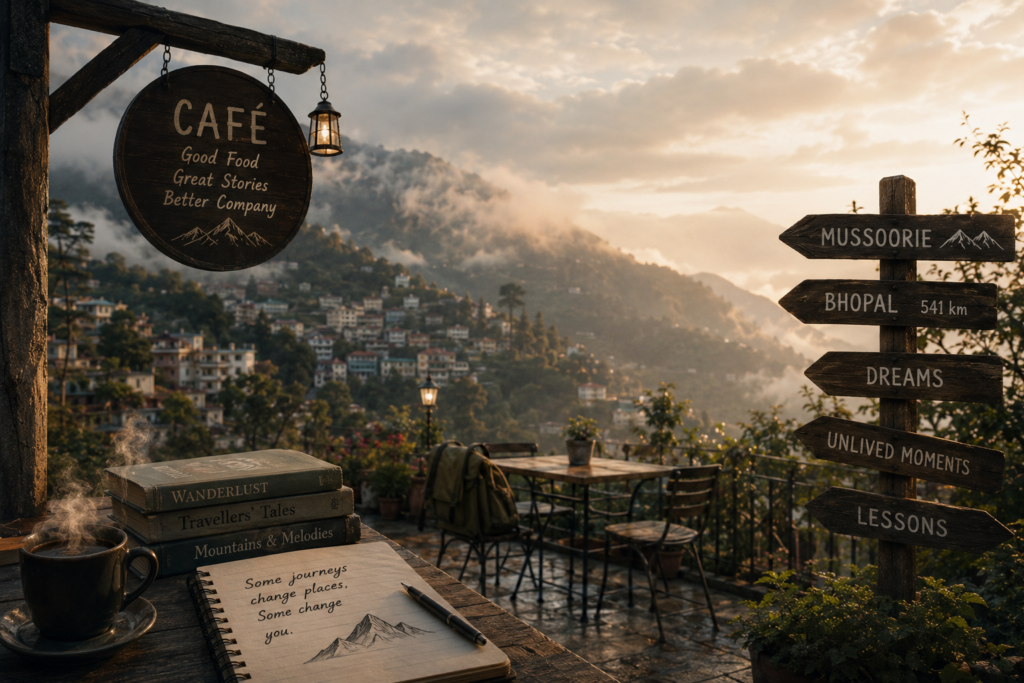
An aspect that fascinated me about Musafir Café is the way it talks of mountains and presents it as an endearing character. An orophile, I resonate with Chander when he affirms that mountains never change people, they merely reflect who they are. Such observations are so invigorating as are the conversations around women going on solo trips and sharing their experiences to inspire others. Intentional living and self-discovery are equally engaging approaches that the series serves and you could be left wondering if existing is enough and chasing in life, overrated, or if love can change one even if he gets lost in it.
The soulful music composed by Garvit-Priyansh and Raghav Kaushik and the resonating voices of Rekha Bhardwaj and Jonita Gandhi certainly need a special mention. The acoustic-driven soundtrack enhances the intimate mood of the story and creates a warm space for the unfolding of personal journeys. From rhythmic numbers to reflective tracks, the music underscores the feeling that stories always continue, even if the characters, the settings and the incidents alter and evolve.
The ending of Musafir Café is equivocal and enigmatic. I loved this touch of authenticity that got it closest to real life, which can never be perfectly tied or put into boxes. It keeps streaming live whether you are watching it or not even after the credits keep rolling. Life does not leverage closure (though relationships demand it) and it is best for the musafir to move on in life and in the series.
I will leave you with the words of the legendary Chinese philosopher, Lao Tzu:
“A good traveller has no fixed plans, and is not intent on arriving.”


By Promita Banerjee Nag
An avid word enthusiast and content-churner, Promita is fuelled by novel writings, ideas and light-hearted banter. A teacher by passion, she treads the path of unequivocal learning with and through her students. Mother, music and ‘mishti’ mostly convince her. If you wish for a tête-à-tête, feel free to reach out to her at promita033@gmail.com.









I have mixed feelings for the series too. May be time has matured me . They left the series at a cliffhanger…so may be there is a possibility of a season 2
I wouldn’t want a Season 2 since the ambiguity feels more authentic (life-like) to me than any closure…
Unfortunately I don’t watch webseries anymore otherwise I would have considered this.