







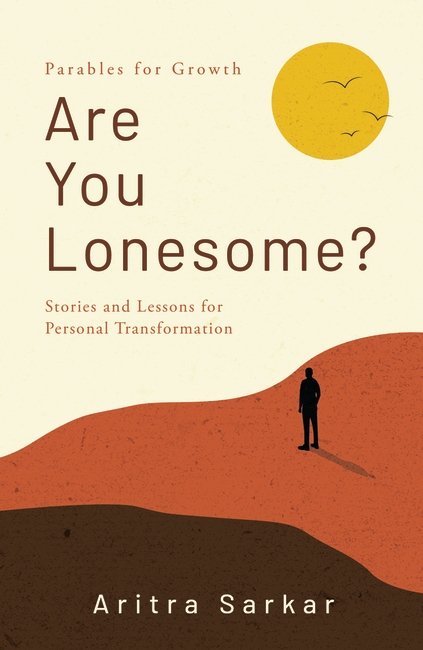
If you feel loneliness is the latest epidemic that is spreading across societies and is steadily becoming a serious threat to humans at large, ARE YOU LONESOME? by ARITRA SARKAR is a book you would want to read and reflect on. An interesting combination of six stories, which serve like case studies and personal insights on each one of them, the book showcases the everyday struggles of people from diverse backgrounds and with varied ‘voids’ in them.
Uncomfortably real and immensely relevant, Are You Lonesome? explores the experience of ‘isolation’ in today’s world and why it is necessary to understand the evolving nature of human connection. It identifies six discrete forms of isolation, analyses the manifestations of each one of them and then through the singular stories offers meaningful means to mend them.
The blend of fiction and facts is what makes the framework of the book, distinctive and its appeal, accessible. The juxtaposition is, however, neither forced nor overwhelming. Rather, it helps in the organic emergence of practical strategies, that the reader can rely on with ease and endurance. In fact, as a reader, I find the methodology most apt as it offers the distance of fictional pieces along with the proximity of lived experiences. So, you might just confront yourself or recognise parts of you in one of the characters and yet stand apart and observe her life till you are ready to imbibe her strategy, perhaps in your own way, towards self-healing. A deviation from the stereotypical self-help structure, this format is, however, central to the book and its purpose – Personal Transformation.
Every story in this book, either through its protagonist or the other characters, shows that most of us never examine the causes behind our behaviour. It is only moments of crisis that compel us to face our fears and encounter our egos. And once we expose our wounds, we are reminded of what or who caused them and only after that we are empowered to heal ourselves. The process is personal, on one level, and collective, on the other. Afterall, only when we can be kind to ourselves, can we be compassionate to others. And then we can stop seeing someone as an embodiment of their entitlement and accept them as someone like our own self. A breathing person with flaws, fears and frustrations.
The first story illustrates the Moral Support Void through the character of the musician, Jack Wilson. It traces the trajectory of his life right from childhood to the present-day and how ‘encouragement gap’ and cruel criticism plays a pivotal role in shaping his personality. But then there are opportunities when you refuse to be reduced to your flaw and “accept yourself as you are,” and it is under those circumstances that you are metamorphosed. How did Jack overcome his void and did he find a voice that could tell others to pursue their passions, even if the path posed challenges and isolation?
The second story depicts the author’s unfeigned understanding of a fallen angel and his earnest intention to probe into the reasons that provoked the fall. Exposing the life of Sarita Menon, this story throws light on Friendship Void and the vices that feast on the vacuum. A wife and a mother, Sarita’s hands are full but her heart feels heavy with bitterness and betrayal. But friendships come in the most fascinating forms and the best ones are forged through “a shared purpose.” Sarita’s story teaches you to stop seeking external validation and befriend yourself before craving connections with others.
The authentic ask, “Am I being myself?” lies at the heart of the third story of the book as it attempts to analyse the Connection Void that looms large in the life of Carla Bohm and the picture-perfect future that awaits her. The story reminds me of the poem The Road Not Taken by Robert Frost and I can almost hear Carla saying, “I took the one less travelled by, / And that has made all the difference.” Find out for yourself how Carla’s unconventional road helps her return to what truly matters and how she fills up her connection void with courage and compassion.
To heal in the present, one has to stand face-to-face with the past. Every story has instances where the present scene dissolves into dimness enabling the change of characters, props and timelines for the next scene to come alive. It is almost like watching a theatrical performance. However, there are times when this particular technique appears repetitive and predictable and thereby loses the emotive power of the presentation. Nonetheless, the stories by themselves have the potential of being turned into celluloid and cater to a bigger audience.
Desire demands direction and like Sushmita, the protagonist of the fourth story, if you “need a guide” to go further in life, her predicament will certainly pique your interest. So close felt her dilemmas and disappointments that I could empathise with her when every task became “an uphill battle she wasn’t equipped for.” The way her aspiring-writer’s mind worked, took me back to Graham Greene’s ‘method of writing’ where words and sentences are formed in the most unexpected places and long before they are actually written. But then there is a twist in the tale. Who fills up Sushmita’s Guidance Void and how does she ultimately emerge as a ‘whole’?

The fifth story uses “strong language and mature themes” to deal with emotional emptiness or the Companionship Void that Austin has to combat within by crafting a life pivoted on creative purpose. Only when one sees herself, she shines and then she becomes visible to the world through her own light. The Intimacy Void of the final story makes it evident that this particular void stems from the refusal to risk vulnerability and make do with quick fixes and compromises. Go ahead and see who gives first and freely and whether the act of fullness causes the void to vanish and the connection to coagulate.
It is only an empath, who can delve into the distressing feeling of isolation with such depth. The language of the book bears testimony to the same but is also supported by evidences of analytical thinking and acute awareness of psychological concepts. Nevertheless, the language is lucid and the casual flow of the narrative makes it an effective read for adults and teenagers alike. Of course, there are impressive analogies like ‘Moments stretched like elastic, thick with uncertainty’ or ‘an avalanche of unsaid words’ that will compel the reader to pause and ponder on their implications much before they embark on their very own personal journeys.
The ultimate aim of the book is to advocate the idea that correction or transformation has to start within to bring about enduring reforms in the little worlds we inhabit. And a minute shift in the microcosm will inevitably lead to a conspicuous change in the macrocosm. But instead of being instructive, Are you Lonesome? achieves its purpose by presenting voids, which eventually open up to vistas that offer varied possibilities from which the protagonists can chose to carve a life of passion and purpose.
I think I will keep going back to the book that is imbued with the essence of William Cowper’s lines from The Solitude Of Alexander Selkirk… “I am out of humanity’s reach;/ I must finish my journey alone;” to reassure myself that external transformation is attainable and sustainable only when it is achieved through internal awakening.

By Promita Banerjee Nag
An avid word enthusiast and content-churner, Promita is fuelled by novel writings, ideas and light-hearted banter. A teacher by passion, she treads the path of unequivocal learning with and through her students. Mother, music and ‘mishti’ mostly convince her. If you wish for a tête-à-tête, feel free to reach out to her at promita033@gmail.com.







This is a crucial topic. Being hyper-i dependent myself, I have associated myself as a loner…but I do feel loneliness at times. But the people around cannot think with the same depth. By the way…Amar toh porar chaap bere jachchhe with every review you publish
All I can say to that is…hugs!
A thoughtful n beckoning piece!!!
Very impressive 🎉🎉🎉
Thank you for engaging!
I had thought of not buying any more books this year but this book review is tempting me to break the vow. 😊 Maybe I can just earmark it for January.
That’s so endearing, Richa!