





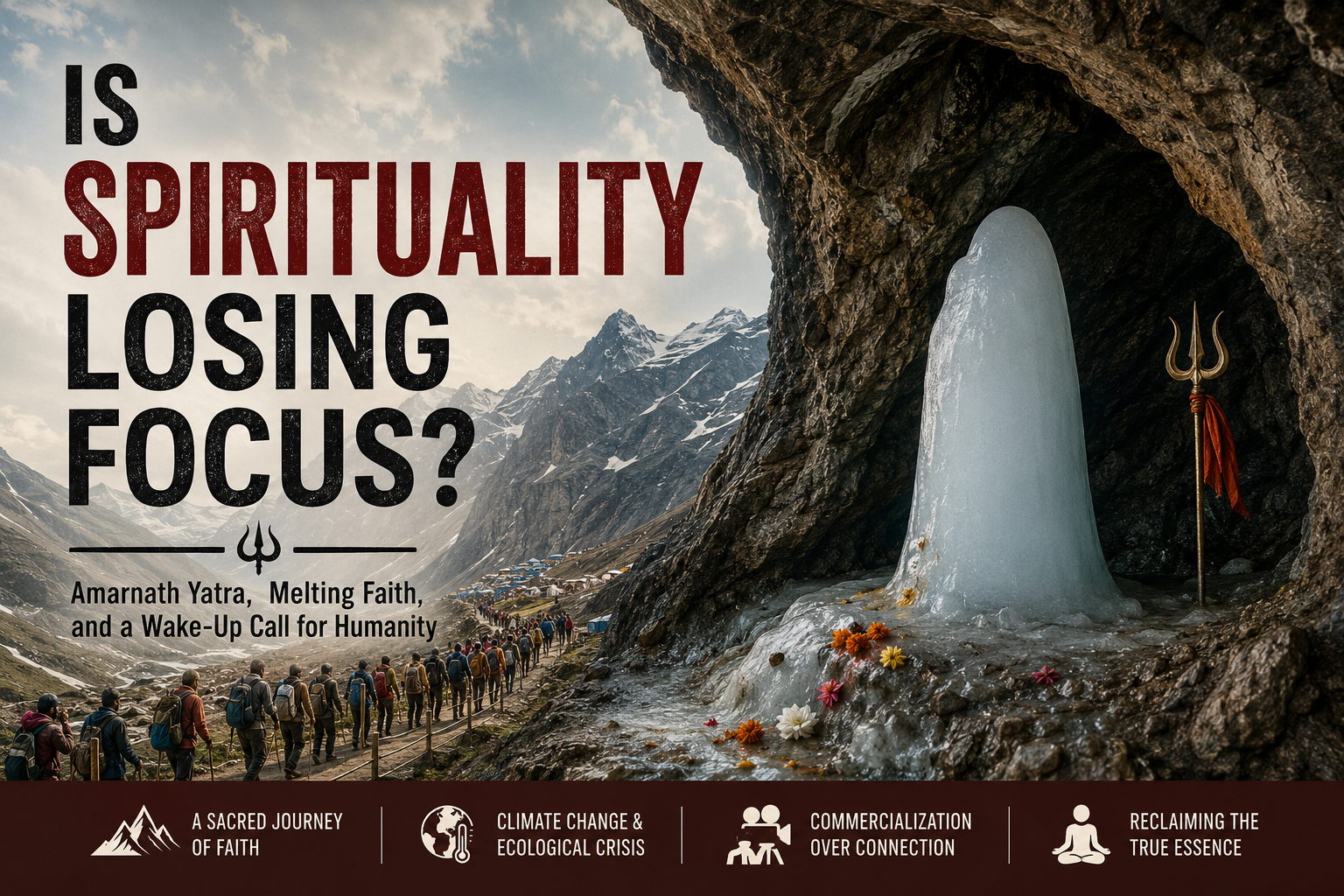

The Amarnath Yatra is one of Hinduism’s most significant pilgrimages in India. This year, the annual pilgrimage is adversely affected due to unforeseen early melting of the natural ice sculpture or ‘shivling’. This is an opinion piece by the author on various scientific causes as well as a reflective take on the intangible reasons that may be affecting this renowned shrine visit.
The Factual details
The Amarnath Yatra is one of Hinduism’s most significant pilgrimages, centred on the Amarnath Cave in Jammu and Kashmir, India. The cave is situated in the Himalayas at an altitude of about 3,880 meters (12,730 feet), in the Kashmir Valley, roughly 141 km from Srinagar. Inside the cave, an ice stalagmite forms naturally each year, waxing and waning with the lunar cycle, and is worshipped as a symbolic manifestation of Lord Shiva in the form of a Shivling. Two smaller ice formations nearby are traditionally associated with Parvati and Ganesha.
Mythological background
According to Hindu mythology, this is the cave where Lord Shiva revealed the secret of immortality to Parvati. To ensure no living being overheard, he is said to have abandoned his bull Nandi, released the moon from his hair, left his snakes, and shed other divine associations along the way — which is how nearby places like Pahalgam and Sheshnag got their names.
This cave finds mention in ancient texts, and a 19th-century European visitor’s accounts and earlier Kashmiri chronicles which reference a Shiva shrine in the region.
Formalization of the Yatra
The Amarnath yatra became more organized in the 19th century. The Shri Amarnathji Shrine Board (SASB) was established by the Jammu and Kashmir government in 2000, and it went on to be the one stop centre to manage registration, security, facilities, and route logistics. Today it draws hundreds of thousands of pilgrims annually over roughly 3-5 weeks, between July and August which are the Hindu months of Shravan, culminating around Shravan Purnima/Raksha Bandhan.
Calamities the Yatra has faced over the years
Due to its location right in the heart of the Kashmir valley and related security concerns in the region, the yatra is always carried out under heavy security arrangements by the Indian Army, CRPF, and J&K Police. We have still seen many terrorist attacks on the pilgrimage, either directly targeting the same or being affected as a collateral. Alongside have been natural disasters aplenty.
Terrorist Attacks –
· The yatra was suspended altogether from 1991 to 1995 due to the peak of militancy in Kashmir, though a limited number of pilgrims still made a bid with risks.

· 1993–1998 ban: Ban due to the demolition of the Babri Masjid
· 2000 Pahalgam massacre: Hizbul Mujahideen militants massacred at least 32 Hindu pilgrims and injured around 60 people in a two-hour shoot-out at the Nunwan base camp. This was part of a coordinated set of attacks across the valley that killed at least 89 to 105 people in total.
· 2002 Nunwan attack: Terrorists attacked the Nunwan camp before dawn, killing 8 and injuring 30 pilgrims
· 2006 attack: Buses carrying pilgrims were attacked with grenades in a heinous incident
· 2017 Anantnag attack: In July 2017, 8 Hindu civilian pilgrims were killed and at least 19 injured when terrorists fired on their bus

Natural Calamities –
· 1996 snowstorm tragedy: This remains the deadliest single incident in the yatra’s history — over 250 pilgrims died due to a sudden change in weather, catching a surge of pilgrims unprepared in the high-altitude terrain. This sudden weather event is cited as the worst natural tragedy associated with the yatra
· Periodic casualties caused by ecological imbalances, flash floods, avalanches, cloud bursts and snowstorms
Critical Eco-Balance Disturbed
However, the latest phenomenon to plague the pilgrims and organizers is that the sacred ice Shivling has shrunk from about seven feet tall in May to roughly one foot by July 6 and is now gone entirely by July 7. Although an official statement has not corroborated this, people claim that the sculpture has completely disappeared. This means most of the 57-day pilgrimage will proceed without the ice formation being visible at all — a significant blow for pilgrims who trek for days specifically to witness it. Similar incidents have also occurred in the near past, and this is the third consecutive year when the Shivling has all but vanished so early into the yatra.
While many scientific reasons are being cited for this, overall climate change and environmental degradation main among them, one other significant point is the uncontrolled infrastructure expansion which is threatening the fragile ecosystem. In trying to gain popularity and increase footfalls, the ones in charge have been stretching the Supreme Court-mandated limit of 10,000 pilgrims per day even further. This is the situation not only in Amarnath but also in many other parts of the Himalayas where unnecessary human interference and construction of highways on the top layers of critically poised mountain ranges, is creating major upheavals in nature.
Now add to this the influencers and the vloggers who treat every meal, every shrine, every walk, every birth and even every death as content, and you have more problems than solutions. Unfortunately, just planting a few more trees or wasting a little less water will not be enough to deal with such major challenges.
It is time we recognize a pilgrimage as what it represents. A long-yearned trip for the old and young, overcoming some obstacles both physical and psychological, to cleanse the soul and feel closer to the divine. What the pilgrims need is security from the militant outfits, safe roads and reliable medical facilities along the way. Perhaps they’d also welcome fewer credit-hogging cameras and lesser officials tampering with the landscape, and instead, the space to simply create memories that last a lifetime.

Manobina Nanda Ganguly
Manobina is a Computer Engineer by profession, working for over two decades. An avid reader since childhood, she loves reading both fictions and non fictions. She can be reached at manobina@gmail.com.








A very pertinent ecological issue has been addressed through the perspective of faith and fervor…insightful indeed!
loved it. crisp and precise.