





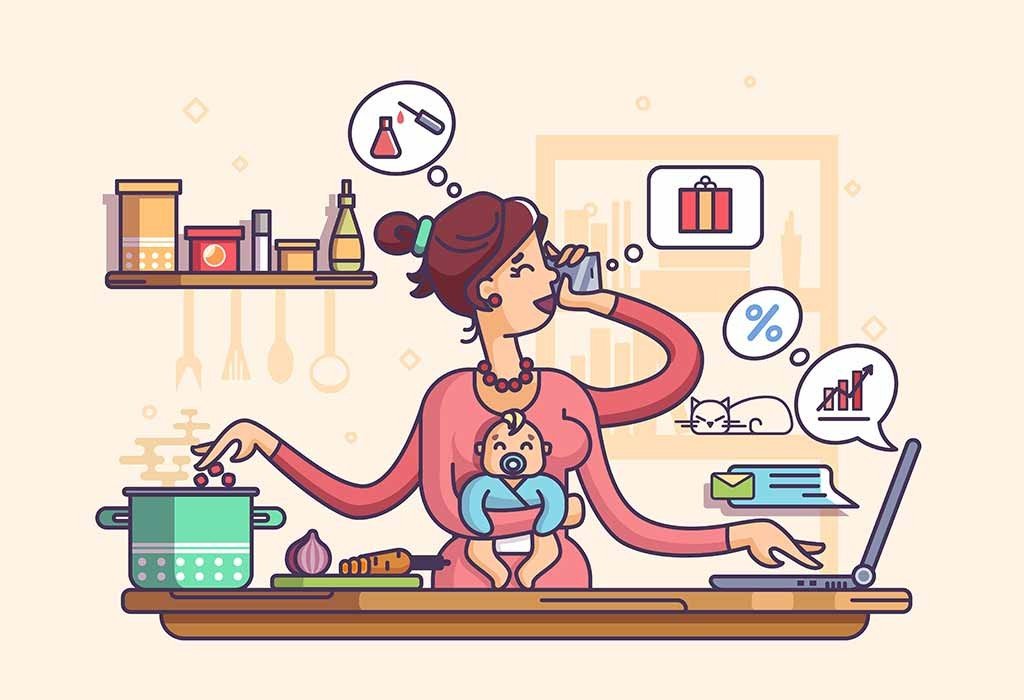

The term “working mother” is a paradox to begin with, because mothers are always working. Being a mother is a round-the-clock job, with or without a profession. Much of this is invisible labour, since it is unpaid. When she takes on a profession, balancing paid work with motherhood becomes like carrying two full-time jobs.
Challenges
There is undoubtedly a double burden on working mothers – they have to manage both paid work and the unpaid role of motherhood, essentially two full-time jobs. The trap of perfection looms large, with impossible expectations to excel equally at work and at home. Persistent guilt sets in — the feeling of never doing enough for the children, household, or career. This often leads to constant fatigue, burnout, and even long-term health issues.
There is hardly any support structure at the workplace, with no special accommodations for mothers, even when demands at home are heavy. Career strain adds to the pressure, with the constant need to stay “visible” at work while simultaneously meeting parental duties. To top it all, a working mother must deal with judgment and criticism — social expectations and sharp remarks from family and friends, regardless of her career achievements.
As Indra Nooyi, the former CEO of PepsiCo, puts it: “Any way you look at it, motherhood is a full-time job — especially when your kids are babies. Being an executive is a full-time job. Being a wife is a quasi-full-time-ish job … There’s only 24 hours in a day and we have to do all these jobs: be a parent, be an executive, be a daughter, and, in the Indian case, also daughter-in-law, and somehow find time for yourself.” Her words echo the reality of countless working mothers who find themselves stretched across multiple identities with too little time.
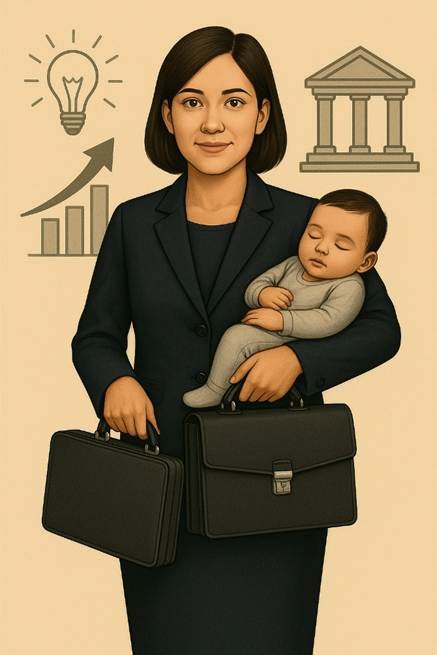
Working mothers also contend with unequal gender roles. As Simone de Beauvoir pointed out in her seminal work The Second Sex, “One is not born, but rather becomes, a woman.” This underlines how parenthood is socially constructed as a mother’s duty, even though fathers should play an equal role. While breastfeeding in the early years is naturally a mother’s responsibility, what about changing diapers or singing lullabies? Surely fathers can manage these, yet society rarely expects them to. Maternity leave exists in most countries, but paternity leave is often absent, or at best reduced to a token few days. A man is never asked if his career would be affected after childbirth, but a woman always is. Too often, after work, the man unwinds on the couch while the working mother takes on household responsibilities. Why can’t the husband and wife share the load — as shown so beautifully in the Ariel advertisement?
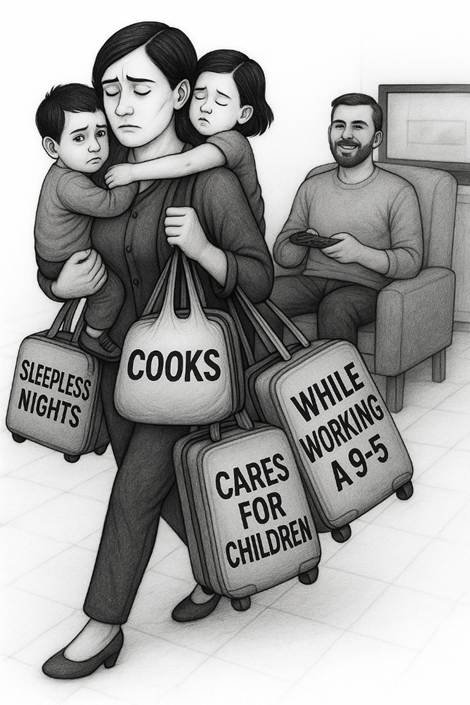
For those in nuclear families, the struggle is even greater. Without extended family or household help, many tasks remain unfinished, adding to stress and guilt. On top of it all, mid-life often brings overload — children’s milestones, career peaks, and the care of aging parents colliding at once. Quoting Indra Nooyi once again, “If you ask our daughters, I’m not sure that they will say I’ve been a good mom.”
The Role of Support Systems
Family support coming from the parents-in-law, or spouses often makes it possible for mothers to balance work and home. Delegation of responsibilities plays an important role. Grandparents, especially mothers-in-law, sometimes take over teaching, childcare, or household tasks or at least supervise them in the presence of domestic help. This brings us to external help provided by nannies, cooks, daycare and domestic staff which ease the burden where families can afford them. There is of course a contrast in nuclear families. Lack of extended family or help increases stress, showing the importance of support systems. “Speak up when you need to arrange for flexibility to look after your family.” — says Pamela Beate, Product Manager. This underlines how asking for support or changes is part of managing the load.
Workplace flexibility is desirable and can act like a boon when it comes to work-motherhood balance. Supportive employers, flexible hours, or work-from-home policies help reduce stress. Some of my cousins have opted for the latter to ease their burden and iron out any wrinkles in their daily routine. Emotional support, that is, encouragement from family, friends and colleagues provides strength and reduces guilt. Appreciation matters: even verbal acknowledgment and appreciation can function as support, reducing the invisible load. Some mothers frame survival as partly due to divine grace or sheer luck.
Shifting Attitudes and Choices
In contemporary times, especially among Gen Z women, more working mothers are learning to step away from the “superwoman” ideal and focus on peace, presence, and self-care, thus letting go of guilt. They have learnt to prioritize themselves, emphasizing mental well-being, happiness, and being present for oneself rather than only for others.
Not all women are choosing motherhood; some prioritize career or personal freedom instead, and that’s seen as wise. I know of women who have frozen their eggs to conceive a child later through IVF when they are mentally ready — throwing to the winds the concept of the ticking biological clock. Such women are redefining motherhood. This choice is empowerment.
Thus, we can say that there is no single formula that suits all. Each woman finds her own rhythm of managing work, motherhood, and life. Many take pride in juggling and, in retrospect, realize that they accomplished more than they thought possible — and deserve to pat themselves on the back.
Recognition & Appreciation
Both stay-at-home mothers (SAHMs) and working mothers carry heavy responsibilities — comparing them only deepens divides instead of building solidarity. Every mother deserves respect, love, and acknowledgment for her invisible and often undervalued labour. Judgment and criticism from family, peers, or society add to guilt; appreciation can ease the invisible load. Society needs to shift the narrative: instead of asking mothers to justify their choices, value the work they do regardless of form. The idea of the “superwoman” crown should give way to empathy, equality, and shared responsibility. Ultimately, all forms of motherhood are valid — whether at home, in the workplace, or both — and each deserves dignity.

By Richa Verma
Richa is an online English teacher, independent blogger, voracious reader, movie buff who is smitten with wanderlust, and a homemaker. She can be contacted through her email address richavermamh@gmail.com





2 Responses
Even if husbands or in laws do not or cannot contribute physically, but compassionate outlook & appreciation of whatever she( mother) is doing, goes a long way in easing the working mother’s troubles.
Thanks for reading and commenting Mami. You are right. Small appreciation goes a long way in mitigating the feelings of guilt and motivating mothers.